At a glance
The Louis XV style, or rocaille style, is the French decorative style of the 1730s to 1770. It is recognisable by its curving lines, its asymmetrical ornament inspired by shells and plant forms, and its cabriole legs. Parisian pieces of the period often bear the stamp of their maker, compulsory from 1743.
- Period
- 1730 – 1770
- Line
- Curved, bombé
- Ornament
- Rocaille, flowers
- Woods
- Tulipwood, kingwood, walnut
Timeline
- 1715Death of Louis XIV. The Régence softens the forms of the Grand Siècle.
- 1730Rocaille decoration takes hold (Meissonnier, Pineau). The Louis XV style is born.
- 1743New guild statutes: stamping becomes compulsory for Parisian master cabinetmakers (enforced from 1751).
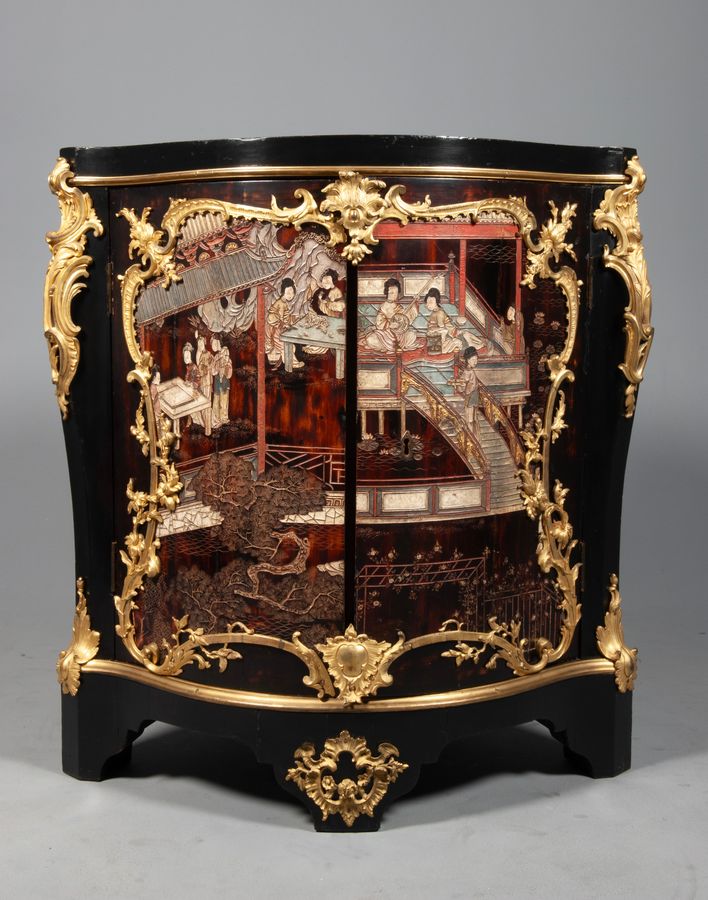
- 1750The high point: commodes ‘sans traverse’, floral marquetry, Far Eastern lacquer.
- 1760A return to antiquity after the excavations at Herculaneum: the Transition style begins.
Recognising Louis XV furniture: the 7 key features
- Cabriole legs in an S-curve, ending in a bronze sabot or a scroll.
- Bombé front and sides, ‘en arbalète’ (crossbow-shaped) or ‘en tombeau’.
- No straight lines: shaped rails and serpentine aprons.
- Asymmetrical rocaille decoration: shells, foliage, cartouches.
- Floral or trellis marquetry in tulipwood and kingwood.
- Fire-gilt bronze mounts accentuating the curves (chutes, escutcheons, sabots).
- Stamp and JME mark on Parisian pieces, following the application of the 1743 statutes (registered in 1751).
Régence, Louis XV, Louis XVI compared
| Feature | Régence | Louis XV | Louis XVI |
|---|---|---|---|
| Dates | 1715–1730 | 1730–1770 | 1770–1790 |
| Line | Symmetrical curves | Curved, asymmetrical | Straight, symmetrical |
| Legs | Cabriole, restrained | Cabriole, sabots | Tapering, fluted |
| Ornament | Central shell, espagnolettes | Rocaille, flowers | Beading, ribbons, trophies |
The great Louis XV cabinetmakers
- Jean-François Oeben (1721–1763), cabinetmaker to the king, master of mechanical furniture.
- Bernard II Van Risenburgh (BVRB, c. 1700–1766), virtuoso of lacquer and floral marquetry.
- Jacques Dubois (1694–1763), lacquer commodes with exuberant gilt-bronze mounts.
- Jean-Pierre Latz (c. 1691–1754), exceptional bronzes and marquetry.
Seat furniture: essential vocabulary
The Louis XV style coined much of the seating vocabulary still in use today:
- À la reine armchair: a flat back, made to stand against the wall in state rooms.
- Cabriolet armchair: a curved back that follows the sitter’s back, lighter and easy to move, for rooms intended for conversation.
- Bergère: a deep armchair with upholstered sides and a loose seat cushion.
- Marquise: a wide bergère seating two in close quarters, ideal for conversation.
- Duchesse: a chaise longue, either in one piece or « brisée », divided into two or three sections.
In Paris, seat furniture was the preserve of the chair makers (menuisiers en sièges), distinct from the cabinetmakers: Nicolas Heurtaut, Jean-Baptiste Tilliard, Nicolas-Quinibert Foliot and Louis Delanois. They worked mainly in beech, then painted or gilded and carved with small flowers and foliage; provincial makers favoured walnut, left in its natural state. See our section on antique chairs and seating.
Lacquer and vernis Martin
The taste for the Far East led the marchands-merciers to have Chinese and Japanese lacquer screens and cabinets cut up, their panels then shaped and veneered onto Parisian commodes. BVRB was among the cabinetmakers who worked these lacquers with the greatest virtuosity.
With genuine lacquer in short supply, French workshops developed imitations. The most famous were those of the Martin brothers, granted a royal privilege in 1730: vernis Martin has since denoted these coloured varnishes, sometimes heightened with gold, applied to furniture, boxes, carriages and fans.
Marquetry and gilt-bronze mounts
Louis XV marquetry reached remarkable refinement. Flower sprays, scrolling foliage and trellis or cube patterns combine tulipwood, kingwood, purpleheart and pale woods; some elements were stained or shaded in hot sand to give depth, then engraved. These coloured woods have often faded in the light: their original brilliance can sometimes still be seen inside a drawer or beneath a mount.
The mounts, cast, chased and then mercury-gilt, follow the curves of the piece. Some bear a small crowned C, the hallmark of a tax on copper-alloy works levied from 1745 to 1749: it offers a valuable clue to dating.
The style in the decorative arts
Rocaille spread to every kind of object. The goldsmith Juste-Aurèle Meissonnier, followed by Thomas Germain and his son François-Thomas, gave silver writhing forms of shells and foliage. Clockmakers housed their movements in wall-hung cartel clocks of bronze or marquetry, or in clocks set on matching brackets. The Vincennes manufactory, moved to Sèvres in 1756, produced soft-paste porcelain with coloured grounds and delicate flowers. Lyon silks, strewn with flowers and ribbons, covered both seat furniture and walls.
Provincial Louis XV and copies
The Louis XV style spread widely throughout the French provinces. Provence, the Lyonnais, the Bordelais, Normandy and Brittany developed their own forms: carved armoires, solid walnut commodes, buffets and rush-seated chairs. Many of these pieces were made late, sometimes well into the 19th century, in a Louis XV spirit.
The 19th century also produced countless Parisian copies of uneven quality, under Louis-Philippe and then the Second Empire. To tell a period piece from a later one in the style, see our guide period or style.
Frequently asked questions
What is the difference between a fauteuil à la reine and a cabriolet armchair?
What is the 'crowned C' mark?
What are the dates of the Louis XV style?
How can you tell Louis XV from Louis XVI?
Is ‘Louis XV style’ furniture antique?
Sources: Pierre Kjellberg, Le Mobilier français du XVIIIe siècle, 2002 · Musée des Arts décoratifs, 18th-century collections · Wallace Collection, catalogue of French furniture.