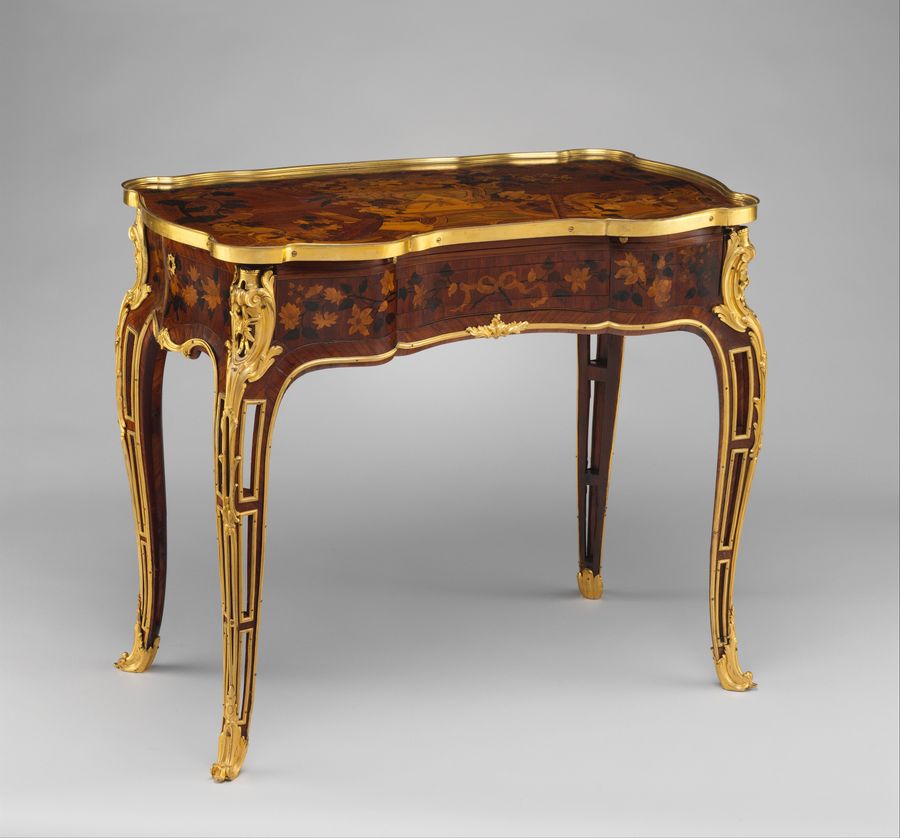
At a glance
The Transition style (c. 1760 to 1775) pairs the still-curved silhouette of Louis XV with the neoclassical ornament of the coming Louis XVI style: Greek key, Vitruvian scroll, interlacing, laurel garlands. It grew out of the Parisian « goût grec », fuelled by the excavations at Herculaneum and Pompeii.
- Period
- 1760 – 1775
- Line
- Gentle curves, crisp corners
- Ornament
- Greek key, Vitruvian scroll, interlacing
- Woods
- Tulipwood, amaranth, sycamore
Context
In the mid-18th century, the discoveries at Herculaneum and Pompeii, followed by the publications of the Comte de Caylus, sparked a reaction against rocaille exuberance. Parisian connoisseurs embraced the « goût grec ». Cabinetmakers at first kept the curved forms their clientele was used to, but dressed them in antique ornament: this was the Transition.
Timeline
- 1738Excavations begin at Herculaneum.
- 1748Excavations begin at Pompeii.
- 1752First volume of the Comte de Caylus's Recueil d'antiquités.
- 1756–1757Furniture « à la grecque » designed by Le Lorrain for Lalive de Jully.
- 1774Accession of Louis XVI: Neoclassicism triumphs.
How to recognise the Transition style
- A still-curved silhouette — but a softened curve, with crisper corners.
- Breakfront façades — with straighter aprons.
- Gently cabriole legs — or already straight, sometimes on the same piece.
- Geometric marquetry — cube parquetry, lozenges, ribbons or antique-style urns.
- Neoclassical mounts — Greek key, Vitruvian scroll, beading, water leaves, laurel garlands.
- A blend of two idioms — on a single piece: this is its hallmark.
Signature pieces: breakfront commode, roll-top desk, fall-front secretaire, writing table, chiffonnier.
The Transition style and its neighbours
| Feature | Louis XV | Transition | Louis XVI |
|---|---|---|---|
| Period | 1730 – 1770 | 1760 – 1775 | 1770 – 1790 |
| Line | Curved, asymmetrical | Gentle curves, crisp corners | Straight, symmetrical |
| Legs | Cabriole, with hoof feet | Gently cabriole | Tapering, fluted |
| Ornament | Rocaille, flowers | Greek key, Vitruvian scroll, interlacing | Beading, ribbons, trophies |
| Woods | Tulipwood, kingwood, walnut | Tulipwood, amaranth, sycamore | Mahogany, tulipwood, satinwood |
A Transition piece is recognised by the deliberate tension between form and ornament: a Louis XV curve with Louis XVI decoration. If the line is entirely straight and the legs tapered, it is Louis XVI; if the decoration remains rocaille and asymmetrical, it is Louis XV.
The Great Names
- Jean-François Oeben (1721 – 1763), cabinetmaker to the king and forerunner of the Transition style.
- Roger Vandercruse, known as Lacroix (1728–1799), stamp RVLC.
- Pierre Garnier (c. 1726 – 1806), among the first cabinetmakers to embrace the goût grec.
- Jean-François Leleu (1729 – 1807), pupil of Oeben.
Transition Seat Furniture
Chair makers embraced the goût grec at the same time as cabinetmakers. The Transition armchair often retains a cabriolet back and slightly cabriole legs, but the seat rail straightens and is covered with antique motifs: guilloche, heart-and-dart and water-leaf friezes. The back sometimes takes a medallion shape or fits within a rectangle with softened corners. The dé de raccordement, a small block carved with a rosette at the junction of leg and seat rail, appears at this time and would become a hallmark of Louis XVI. Louis Delanois was among the first chair makers to interpret this new idiom.
Marquetry, Woods and Mounts
Marquetry becomes geometric. Perspective cubes, lozenges, rosettes and interlaced ribbons replace rocaille bouquets; smoking urns, trophies or musical instruments appear at the centre of façades. Cabinetmakers combine tulipwood, amaranth, satinwood and pale woods, among them sycamore stained grey, known as « bois gris », which offers subtle contrasts.
The mounts too adopt a new vocabulary: Greek key friezes, Vitruvian scrolls, piastre beading, laurel garlands, rams' and lions' heads. On the finest pieces, notably those from the workshop of Oeben and his successors, these mounts are closely integrated with the marquetry.
The Transition Beyond Paris
While the Transition was above all a Parisian phenomenon, the provinces interpreted it in their own way. One finds walnut or cherrywood commodes with a gentle bombé, whose breakfront façade or slightly cabriole legs are paired with straight mouldings. These regional pieces often postdate their models and carry the formula through to the end of the century. The 19th century also copied the Transition style, particularly for small marquetry pieces.
Examining a Transition Piece
The blend of idioms that defines the Transition invites confusion and alteration. A few points to check:
- Consistency of the mounts: a Louis XV commode may have been updated with neoclassical gilt-bronze mounts, either at the time or later. Traces of earlier fixings, filled holes or differences in patina reveal such alterations.
- The stamp: the master's working dates must be consistent with the style; a stamp alone is not enough to authenticate a piece.
- Construction: oak carcass, old drawer bottoms, wear to the drawer runners and keyholes.
Our guide to authenticating a piece of furniture explains these checks in detail.
Frequently asked questions
Is Transition a true style?
What is the « goût grec »?
What is cube marquetry?
Can a Transition piece be stamped?
Sources: Guillaume Janneau, Les Styles du meuble français, PUF, 'Que sais-je ?' series · Musée des Arts décoratifs, Paris — permanent collections · Musée d'Orsay, decorative arts collections · Musée de l'École de Nancy.