At a glance
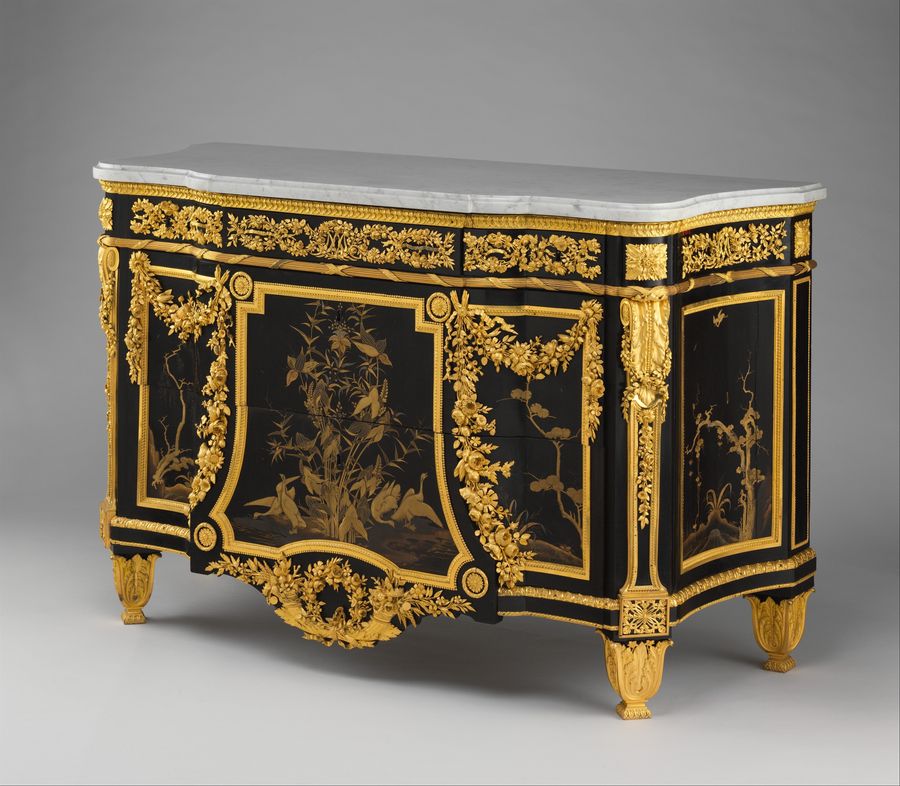
The Louis XVI style (c. 1770 to 1790) returns to the straight line and to a symmetry inspired by antiquity: tapering, fluted legs, friezes of beading and heart-and-dart, ribbons, trophies and garlands. Parisian cabinetmaking reached its technical zenith, with Riesener, Weisweiler and Carlin.
- Period
- 1770 – 1790
- Line
- Straight, symmetrical
- Ornament
- Beading, ribbons, trophies
- Woods
- Mahogany, tulipwood, satinwood
Context
Neoclassicism, already present in the goût grec, came fully into its own with the accession of Louis XVI in 1774. Marie-Antoinette commissioned exquisite furniture for Versailles, the Trianon, Saint-Cloud and Fontainebleau. Anglomania made solid mahogany fashionable, while the marchands-merciers had Sèvres porcelain plaques mounted on small pieces of furniture.
Timeline
- 1769Riesener delivers Louis XV’s cylinder desk, begun by Oeben.
- 1774Accession of Louis XVI; Riesener becomes cabinetmaker-in-ordinary to the Crown.
- 1787Georges Jacob delivers the “Etruscan” chairs for the Rambouillet dairy.
- 1791Guilds abolished: the stamp is no longer compulsory.
How to recognise the Louis XVI style
- Straight lines and symmetry — in silhouette and decoration alike.
- Tapering legs — fluted or stop-fluted, ending in toupie feet.
- Corner blocks — carved with a rosette, where the legs meet the apron.
- Friezes — of beading, egg-and-dart, heart-and-dart or acanthus leaves.
- Classical motifs — ribbons, bows, laurel garlands, trophies, medallions, urns.
- Geometric marquetry — or Sèvres porcelain plaques.
- Seating — with medallion, cocked-hat (chapeau de gendarme) or rectangular backs.
Signature pieces: breakfront commode, roll-top desk, bonheur-du-jour, fall-front secretaire, console desserte, medallion-back armchair, bergère.
The Louis XVI style and its neighbours
| Feature | Transition | Louis XVI | Directoire |
|---|---|---|---|
| Period | 1760 – 1775 | 1770 – 1790 | 1789 – 1804 |
| Line | Gentle curves, crisp corners | Straight, symmetrical | Straight, pared-back |
| Legs | Gently cabriole | Tapering, fluted | Sabre or tapering |
| Ornament | Greek key, Vitruvian scroll, interlacing | Beading, ribbons, trophies | Palmettes, lozenges, stars |
| Woods | Tulipwood, amaranth, sycamore | Mahogany, tulipwood, satinwood | Mahogany, fruitwoods |
Louis XVI differs from the Transition style in its complete abandonment of curves, and from Directoire in its richer ornament (gilt-bronze mounts, friezes, marquetry). Beware: the Louis XVI style was widely copied under Napoléon III, as Empress Eugénie revered Marie-Antoinette. 19th-century copies have machine-sawn carcasses and softer, less crisply chased mounts.
The Great Names
- Jean-Henri Riesener (1734 – 1806), cabinetmaker-in-ordinary to the French Crown.
- Georges Jacob (1739 – 1814), chair maker to Marie-Antoinette.
- Adam Weisweiler (1744 – 1820), cabinetmaker of precious small furniture.
- Martin Carlin (c. 1730 – 1785), furniture mounted with Sèvres plaques.
- Jean-Baptiste-Claude Sené (1748 – 1803), chair maker.
- Pierre Gouthière (1732 – 1813), chaser and gilder.
Louis XVI seat furniture
Louis XVI seat furniture retains the forms inherited from the previous reign — à la reine and cabriolet armchairs, bergères and marquises — but translates them into the straight line. The back takes the form of a medallion, a rectangle, a “gendarme’s hat” or a basket handle. The tapering legs, fluted or cabled, are topped by a dice-shaped block; the padded armrests rest on baluster or column supports. The beech frame is gilded or painted, often rechampi, that is, with the mouldings picked out in a second colour.
The great chair makers, Georges Jacob, Jean-Baptiste-Claude Sené and Jean-Baptiste Boulard, stamped their work on the seat rail, most often beneath the back rail.
Chasing and gilding
The Louis XVI period marks the high point of Parisian furniture bronze. Chasers and gilders reworked the casting with the burin, with a goldsmith’s precision, and mercury gilding played on the contrast between burnished and matt surfaces. Pierre Gouthière is traditionally credited with perfecting this exquisitely refined matt gilding. Bronzes were no longer confined to furniture: andirons, wall lights, candlesticks and mounts for porcelain or hardstone vases all formed part of the same decorative scheme.
The style in the decorative arts
Neoclassicism unified the entire interior. Clocks combined white marble and gilt bronze, sometimes with allegorical figures or vases in the antique manner. The Sèvres manufactory developed biscuit, an unglazed porcelain imitating marble, as well as services with coloured grounds. The Jouy-en-Josas manufactory, founded by Christophe-Philippe Oberkampf, spread its printed cottons for wall hangings and upholstery, while Lyon silks took up medallions, ribbons and garlands.
Provincial work and 19th-century revivals
Provincial Louis XVI furniture, in walnut, cherry or oak, adopts the tapering legs and straight mouldings with simplified ornament. As with earlier styles, this production continued well after 1790, sometimes until the mid-19th century.
Under the Second Empire, Empress Eugénie’s passion for Marie-Antoinette gave rise to the so-called “Louis XVI-Impératrice” style: faithful copies of royal models or freer reinterpretations, sometimes of outstanding quality, yet made with 19th-century methods.
Advice for buyers
- On a chair, look beneath the upholstery: the many nail holes left by successive coverings bear witness to the age of the frame.
- Regilding or repainting is not a deal-breaker, but it should always be disclosed.
- On a commode, check that the marble top is original and that the gilt-bronze mounts are consistent with one another.
- Distinguish between solid mahogany and mahogany veneer: both were used in the period, but they differ in weight and in practical value.
The work of Jean-Henri Riesener offers an excellent benchmark for Parisian quality.
Frequently asked questions
What is a medallion-back armchair?
How can you recognise a period Louis XVI commode?
Why are some Louis XVI pieces made of mahogany?
What is a cabled (rudenté) leg?
What is the “Louis XVI-Impératrice” style?
Sources: Guillaume Janneau, Les Styles du meuble français, PUF, ‘Que sais-je?’ series · Musée des Arts décoratifs, Paris — permanent collections · Musée du Louvre, Department of Decorative Arts · Mobilier national.