At a glance
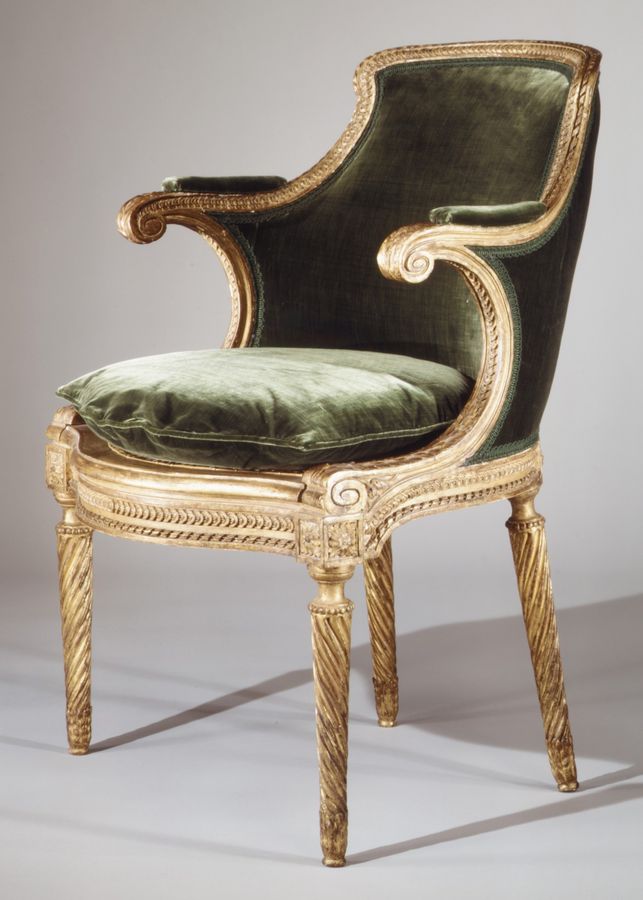
The Directoire style (c. 1789 to 1804) pared back Louis XVI neoclassicism after the Revolution: stricter classical forms, sparing ornament and solid mahogany. Seat furniture, inspired by the Greek klismos, adopted rolled-over backs and sabre legs. It heralded the Empire style.
- Period
- 1789 – 1804
- Line
- Straight, pared-back
- Ornament
- Palmettes, lozenges, stars
- Woods
- Mahogany, fruitwoods
Context
The Revolution abolished the guilds in 1791: stamping was no longer compulsory and the great royal commissions vanished. Workshops adapted to a new clientele with more modest means. The architects Percier and Fontaine and the Jacob brothers established a vocabulary drawn directly from ancient vases and bas-reliefs.
Timeline
- 1791Guilds abolished: the stamp is no longer compulsory.
- 1795The Directoire is established.
- 1796Georges Jacob's sons found Jacob frères.
- 1799Bonaparte's coup d'état: the Consulat (Consulat style, 1799–1804).
- 1804Proclamation of the Empire.
How to Recognise the Directoire Style
- Rolled-over backs — scrolled or gondola-shaped, inspired by the Greek klismos.
- Sabre legs — at the back, with turned spindle or sabre legs at the front.
- Restrained ornament — stringing, lozenges, stars, palmettes.
- Classical motifs — lyres, sphinxes, emerging swans and, more rarely, revolutionary emblems.
- Solid mahogany — and veneer, with little marquetry.
- Inlay — of brass or light-wood stringing.
Signature pieces: scroll-back chair, gondola armchair, bed « à la romaine », upright secretaire, guéridon, console table.
The Directoire style and its neighbours
| Feature | Louis XVI | Directoire | Empire |
|---|---|---|---|
| Period | 1770 – 1790 | 1789 – 1804 | 1804 – 1815 |
| Line | Straight, symmetrical | Straight, pared-back | Massive, cubic |
| Legs | Tapering, fluted | Sabre or tapering | Lion’s-paw feet, toupie feet |
| Ornament | Beading, ribbons, trophies | Palmettes, lozenges, stars | Swans, Victories, palmettes |
| Woods | Mahogany, tulipwood, satinwood | Mahogany, fruitwoods | Flame mahogany, burr wood |
Directoire is more restrained than Louis XVI (fewer mounts, more mahogany) and lighter than Empire (less massive, with sparse mounts). Historians sometimes identify a Consulat style (1799–1804), in which the Egyptian motifs brought back from the Egyptian campaign already appear.
The Great Names
- Georges Jacob (1739 – 1814), chair maker, followed by the family workshop.
- Jacob Frères (1796 – 1803), Georges II and François-Honoré Jacob.
- Charles Percier and Pierre Fontaine (1764 – 1838 and 1762 – 1853), architect-decorators.
Seat furniture, the style’s testing ground
Directoire taste finds its clearest expression in seat furniture. From the late 1780s, Georges Jacob made mahogany chairs copied from Antiquity for the painter Jacques-Louis David, which reappear in his paintings: the fashion for the “Etruscan” manner was launched even before the fall of the monarchy. After the Revolution, this learned model spread and became simpler.
- The back is raked, curved or pierced: horizontal bars, lattice, lozenges, palmettes or a lyre cut from the solid.
- The armrests rest on balusters, colonnettes or scrolled supports, sometimes carved with a sphinx head or a swan.
- The legs often combine a turned or baluster front leg with a sabre back leg, giving the chair a taut, almost nervous silhouette.
To place these chairs within the long history of seat furniture, browse our selection of antique chairs and seating.
Woods, veneers and ornament
Mahogany reigned in Paris, used solid for seat furniture and as veneer for case pieces. Ornament did not disappear but changed in character: instead of chased bronzes and floral marquetry, one finds inlaid brass or ebony stringing, simplified fluting, the odd rosette and pierced brass escutcheons. Marble tops, grey or white, are frequent on commodes, console tables and secrétaires.
Alongside mahogany, seat furniture in painted beech (grey, white, eau-de-nil) remained common, enlivened with painted motifs in the antique manner. In the provinces, workshops used fruitwoods (cherry, walnut) and adapted the Parisian vocabulary with great freedom, often well after 1804.
A style that outlived its era
The dates 1789–1804 are convenient, but Directoire taste did not follow the political calendar. It was already emerging in the final years of Louis XVI’s reign, and its simple forms, inexpensive to produce, lingered for a long time in provincial workshops. A cherrywood chiffonnier with pale stringing may thus have been made under the Restauration. For a buyer the distinction matters: it is the difference between period and style that determines how a piece of furniture is described.
Examining a Directoire piece
- Period mahogany veneer is hand-sawn and fairly thick; a very thin, perfectly even veneer suggests later manufacture.
- Sabre legs are fragile where they meet the back: a reglued break or a replaced leg is common and should be disclosed.
- The absence of a stamp is normal and is no flaw; conversely, a lone stamp on a modest piece of furniture calls for closer scrutiny.
- Alterations do occur: Louis XVI furniture “updated” to suit later tastes, or composite pieces assembled in the 19th century.
The decorative arts of the period
The same taste for antiquity spread to silver, porcelain and clockmaking: amphora- or krater-shaped vases, palmette friezes, draped figures. In silver, the abolition of the guilds disrupted the control of precious metals until the law of Brumaire Year VI (1797), which established a new system of state hallmarks, the basis of 19th-century French marks.
Frequently asked questions
Why is Directoire furniture rarely stamped?
What is a “gondola” back?
What is the klismos?
Is a cherrywood Directoire piece necessarily period?
Sources: Guillaume Janneau, Les Styles du meuble français, PUF, ‘Que sais-je?’ series · Musée des Arts décoratifs, Paris — permanent collections · Musée du Louvre, Department of Decorative Arts · Mobilier national.