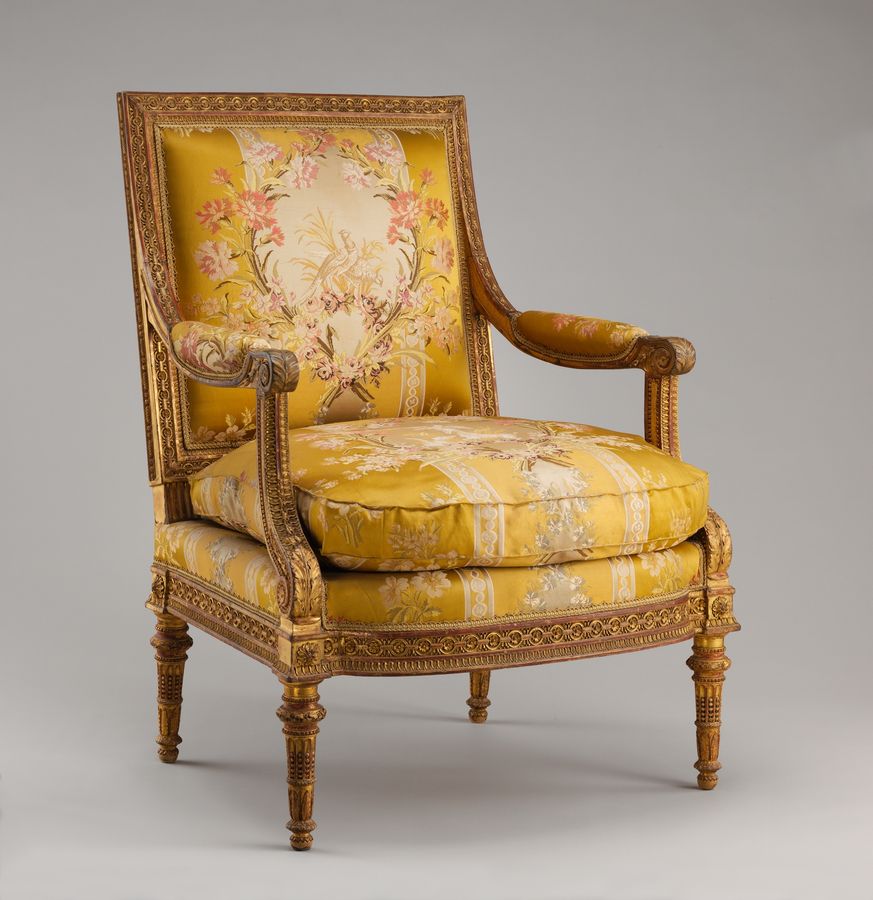
In brief: Georges Jacob (1739–1814) is the most celebrated chair maker of the 18th century. Supplier to Marie-Antoinette and the princes, he founded a dynasty that, through his sons (Jacob Frères, then Jacob-Desmalter), dominated French furniture from Louis XVI to the Empire.
Biography
The son of Burgundian peasants, Jacob arrived in Paris at sixteen and became a master in 1765. He worked for the court, the Comte d’Artois and the Duc d’Orléans, and broke new ground by introducing solid mahogany into seat furniture, together with forms inspired by Antiquity.
In 1787 he delivered the ‘Etruscan’ chairs for Marie-Antoinette’s dairy at Rambouillet. After the Revolution his sons founded Jacob Frères (1796); the workshop later became Jacob-Desmalter, supplier to Napoleon.
Identifying a piece
- Stamp ‘G.IACOB’ (with an I in place of the J).
- Seat furniture with crisp, precise carving.
- Among the first chairs in solid mahogany, with Antique-inspired decoration.
- Louis XVI and later Directoire forms: medallion backs, lyre backs, sabre legs.
Training and early clients
Arriving from Burgundy, Georges Jacob trained in the Paris workshop of Louis Delanois, one of the most prominent chair makers of the reign of Louis XV. Received as master in 1765, he opened his own shop on rue Meslée, an address the family would keep for many years and which appears on the stamps of the following generations.
His clientele soon included the royal family, the princes of the blood and part of the European aristocracy. Among others, he supplied the Comte d'Artois, the Comte de Provence and the Prince de Condé, as well as foreign clients such as the Prince of Wales. His chairs were usually carved, then painted or gilded by other trades, as was customary at the time.
A pioneer of the antique taste
Jacob played a decisive role in the shift from the Louis XVI style to Directoire. He worked for the painter Jacques-Louis David, supplying him with chairs and furniture “à l'antique” inspired by Roman and Etruscan models; these pieces appear in some of the painter's canvases. In this way he popularised scrolled backs, sabre legs, scroll-ended armrests and baluster or tapering uprights.
His technique is flawless: beech or walnut frames for painted and gilded seats, solid mahogany for English-style or antique-inspired models, and crisp carving of heart-and-dart, beading, acanthus leaves and rosettes in the corner blocks.
Jacob frères and Jacob-Desmalter
In 1796 Georges Jacob handed over his business to his two sons, Georges II and François-Honoré, who traded as Jacob frères. On the death of Georges II in 1803, François-Honoré took the name Jacob-Desmalter and went into partnership with his father. The workshop then became the leading supplier of Imperial furniture, often to designs by Percier and Fontaine, for the Tuileries, Saint-Cloud, Fontainebleau and Compiègne.
Georges-Alphonse, son of François-Honoré, carried on the business under the Restauration and the July Monarchy, before the firm was sold to the house of Jeanselme in the mid-19th century.
Stamps and precautions
Each period has its own mark: “G.IACOB” for the founder, “JACOB FRERES RUE MESLEE” for the years of the two brothers, “JACOB D. R. MESLEE” for Jacob-Desmalter. The stamp is struck beneath the seat rail, most often on the back rail or a side rail.
It is one of the most frequently imitated marks in French furniture. A stamp must be consistent with the chair itself: period timber, pegs, traces of earlier upholstery, even wear. From 1791, the abolition of the guilds made stamping optional, so its absence does not rule out a Jacob origin, but an attribution without a mark calls for solid evidence. See also our antique chairs section.
Where to see his work
Château de Versailles, Musée du Louvre, Mobilier National, Metropolitan Museum of Art.
Frequently asked questions
Why does the stamp read “IACOB” rather than “JACOB”?
Is a Jacob chair always made of mahogany?
Sources: Guillaume Janneau, Les Styles du meuble français, PUF, ‘Que sais-je ?’ series · Musée des Arts Décoratifs, Paris — permanent collections · collections of the museums cited.