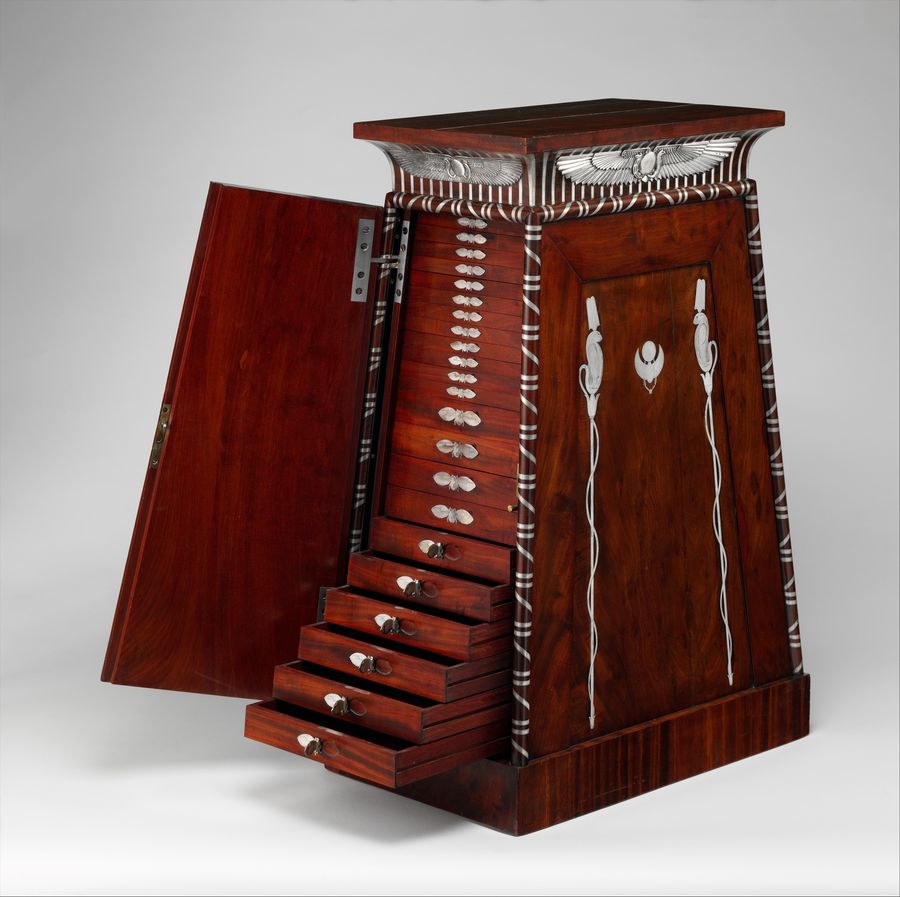
At a glance
The Empire style (1804 to 1815) was the official style of the reign of Napoleon I: massive, symmetrical forms, flame mahogany, gilt-bronze mounts applied to broad flat surfaces, and antique and Egyptian motifs (swans, winged victories, sphinxes, eagles, bees). The architects Percier and Fontaine established its vocabulary.
- Period
- 1804 – 1815
- Line
- Massive, cubic
- Ornament
- Swans, Victories, palmettes
- Woods
- Flame mahogany, burr wood
Context
Napoleon made furniture an instrument of propaganda. The imperial palaces (the Tuileries, Saint-Cloud, Fontainebleau, Compiègne) were refurnished by the Garde-Meuble impérial. Percier and Fontaine published their Recueil de décorations intérieures, which circulated throughout Europe. The bronziers, led by Thomire, produced ornaments of exceptional quality.
Timeline
- 1798–1801Egyptian campaign: the birth of the Egyptian taste.
- 1801Percier and Fontaine begin publishing their Recueil de décorations intérieures.
- 1804Coronation of Napoleon I.
- 1806Continental Blockade: mahogany becomes scarce.
- 1815Waterloo and the fall of the Empire.
How to Recognise the Empire Style
- Massive, cubic forms — with strict symmetry.
- Flame mahogany — or burr mahogany, in broad, smooth surfaces.
- Applied gilt-bronze mounts — set on flat surfaces rather than following the contours.
- Free-standing columns — or terminal pilasters topped with Egyptian heads.
- Feet — lion's-paw or claw, or toupie feet.
- Motifs — swans, winged victories, sphinxes, eagles, bees, laurel wreaths, palmettes.
- Seat furniture — flat, square backs, with scrolled or sphinx-head armrests.
Signature pieces: sleigh bed, cheval mirror, somno bedside table, athénienne, columned console table, upright secretaire, marble-topped guéridon, méridienne.
The Empire Style and Its Neighbours
| Feature | Directoire | Empire | Restauration |
|---|---|---|---|
| Period | 1789 – 1804 | 1804 – 1815 | 1815 – 1830 |
| Line | Straight, pared-back | Massive, cubic | Softened, rounded |
| Legs | Sabre or tapering | Lion’s-paw feet, toupie feet | Hocked or scroll legs |
| Ornament | Palmettes, lozenges, stars | Swans, Victories, palmettes | Inlaid rosettes and palmettes |
| Woods | Mahogany, fruitwoods | Flame mahogany, burr wood | Maple, lemonwood, ash |
Empire differs from the Directoire in its massiveness and profusion of gilt bronzes, and from the Restauration in its dark woods (mahogany), whereas the Restauration favoured pale woods. Beware: the Empire style was widely copied in the 19th and 20th centuries; period bronzes are chased and mercury-gilt, while copies are often cast without finishing and electroplated.
The Great Names
- Jacob-Desmalter (1770 – 1841), cabinetmaker to the Emperor, son of Georges Jacob.
- Pierre-Philippe Thomire (1751 – 1843), bronze maker.
- Martin-Guillaume Biennais (1764 – 1843), goldsmith and fine-wares maker to the Emperor.
- Charles Percier and Pierre Fontaine (1764 – 1838 and 1762 – 1853), the Emperor's architects.
Palace seat furniture
Empire seat furniture conveys the same taste for solemnity as cabinetwork. The back is generally flat and rectangular, sometimes slightly raked; the arms rest on baluster, column, swan or sphinx-bust supports; the front legs are tapering or baluster-shaped, the back legs sabre-shaped. In the palaces, state seating was often in giltwood, while mahogany prevailed in private apartments and bourgeois homes.
Imperial commissions also revived the Lyon silk industry, whose lampas and brocades patterned with bees, crowns and palmettes covered seat furniture and wall hangings. Folding stools and X-frame tabourets, inspired by the Roman curule chair, completed the furnishing of throne rooms and galleries. A selection of antique seating allows their silhouettes to be compared.
How the bronzes were made
An Empire furniture bronze passed through several hands. The model was sand-cast, then the chaser worked each piece with graver and matting tool to restore the relief of a swan's feathers or the folds of a drapery. Next came mercury gilding, known as 'ormolu', which plays on the contrast between matt areas and areas burnished with an agate stone. Alongside Thomire, bronziers such as Claude Galle and Antoine-André Ravrio supplied clocks, candelabra and wall lights to the Garde-Meuble.
Clocks often combine gilt bronze with bronze patinated 'à l'antique' and marble: mythological figures, chariots, allegories and 'Retour d'Égypte' subjects.
Empire in the decorative arts
- Porcelain: under the direction of Alexandre Brongniart from 1800, the Sèvres manufactory produced monumental vases with gold or coloured grounds, and diplomatic services decorated with views and historical scenes.
- Silver: Biennais and Jean-Baptiste-Claude Odiot produced travelling sets, table centrepieces and ceremonial services of a thoroughly architectural rigour.
- Lighting: 'montgolfière' (hot-air balloon) chandeliers hung with crystal drops, bouillotte lamps, candelabra with figures of Victory.
A European style
Through engraved pattern books and the thrones bestowed on members of the Bonaparte family, the Empire style spread to Italy, Spain and the German-speaking lands, reaching as far as Russia and Sweden. Each country adapted it: German and Austrian Biedermeier retained its simple forms but gave up gilt-bronze mounts in favour of pale woods, foreshadowing the taste of the Restauration.
Examining Empire furniture
- Remove a mount with care: the reverse of an antique bronze is left rough from the casting, and it is fixed with old threaded rods and nuts, not cross-head screws.
- Check that the detached columns (bases and capitals, often replaced) and the marble, frequently changed, are consistent.
- Be wary of mahogany that is too red and glossy: a thick modern varnish often conceals restorations to the veneer.
Frequently asked questions
How can you recognise a period Empire bronze?
Why are there Egyptian motifs on Empire furniture?
What is a somno?
What is “ormolu”?
Is an Empire clock always in gilt bronze?
Sources: Guillaume Janneau, Les Styles du meuble français, PUF, ‘Que sais-je?’ series · Musée des Arts décoratifs, Paris — permanent collections · Musée du Louvre, Department of Decorative Arts · Mobilier national.