At a glance
The Restauration style (1815 to 1830) softened the Empire: rounded, lighter forms, pale woods (maple, lemonwood, ash, elm) enhanced with dark-wood marquetry, and fewer bronzes. It spans the reigns of Louis XVIII and Charles X, the latter sometimes distinguished as a ‘Charles X’ style.
- Period
- 1815 – 1830
- Line
- Softened, rounded
- Ornament
- Inlaid rosettes and palmettes
- Woods
- Maple, lemonwood, ash
Context
The return of the Bourbons did not bring a return to Ancien Régime styles: Empire forms endured, but softened. The scarcity of mahogany since the Continental Blockade, together with the taste of the day, favoured pale native woods. Towards the end of the period, the Duchesse de Berry launched the fashion for the Gothic-inspired ‘cathedral style’.
Timeline
- 1814–1815Bourbon Restoration: Louis XVIII.
- 1824Accession of Charles X.
- c. 1825Fashion for the ‘cathedral style’.
- 1830July Revolution: Louis-Philippe.
Identifying the Restauration style
- Pale woods — bird’s-eye maple, lemonwood, ash, elm, amboyna burr.
- Dark-wood inlays — amaranth, rosewood: stringing, rosettes, palmettes.
- Rounded forms — scrolls, volute armrests.
- Fewer bronzes — replaced by marquetry.
- Seating — scrolled or gondola backs, hock-shaped or sabre legs.
- ‘À la cathédrale’ decoration — Gothic rosettes and arcading, c. 1825–1830.
Signature pieces: cheval mirror, lady's writing desk, guéridon, méridienne, chiffonnier, commode with engaged columns, sleigh bed.
The Restauration style and its neighbours
| Feature | Empire | Restauration | Napoléon III |
|---|---|---|---|
| Period | 1804 – 1815 | 1815 – 1830 | 1852 – 1870 |
| Line | Massive, cubic | Softened, rounded | Eclectic |
| Legs | Lion’s-paw feet, toupie feet | Hocked or scroll legs | All styles, castors |
| Ornament | Swans, Victories, palmettes | Inlaid rosettes and palmettes | Brass, mother-of-pearl, buttoned upholstery |
| Woods | Flame mahogany, burr wood | Maple, lemonwood, ash | Ebonised pearwood, rosewood |
The Restauration differs from the Empire in its pale woods and rounded forms, and from the Louis-Philippe style that followed in the quality of its veneers: Louis-Philippe returned to dark woods (mahogany, rosewood) and more industrial production.
The Great Names
- Pierre-Antoine Bellangé (1757 – 1827), cabinetmaker to the Garde-Meuble de la Couronne.
- Jacob-Desmalter (1770 – 1841), still active during the Restauration.
- Jean-Jacques Werner (1791 – 1849), master of pale woods.
Restauration seat furniture
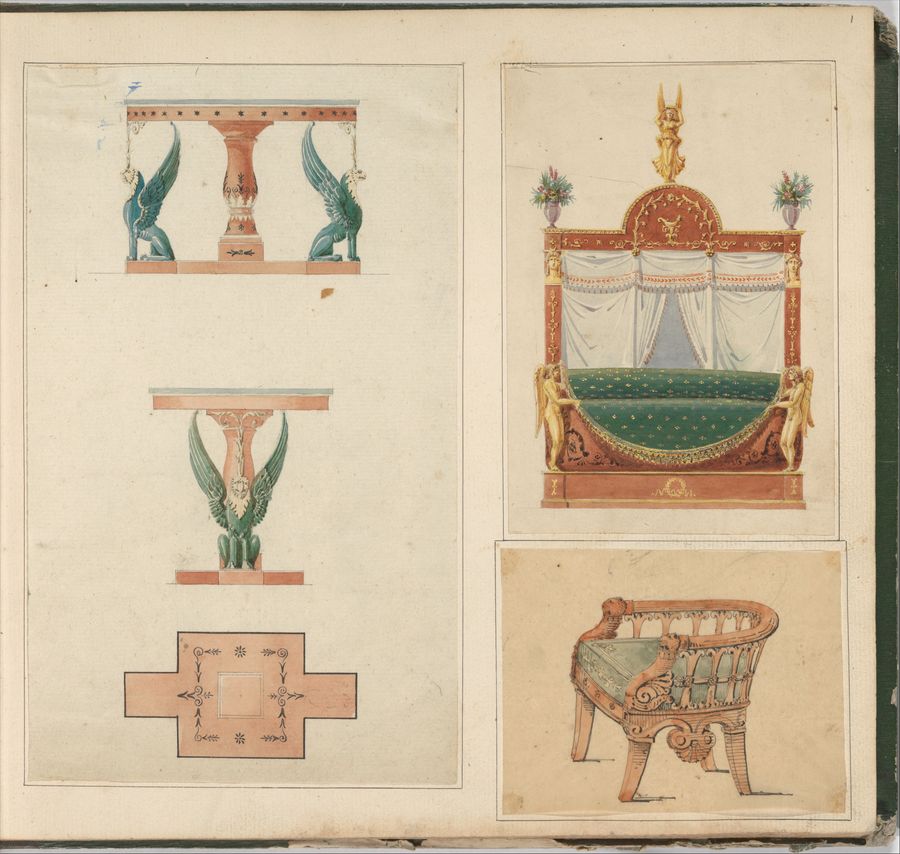
Seat furniture retains the structure inherited from the Empire but softens it. The back is often scrolled over, sometimes pierced with a splat or a rail carved with palmettes and scrolling foliage; the arms end in a volute or scroll, the front legs are hocked or console-shaped and the back legs sabre-shaped. Chairs frequently feature dark wood inlay on the back rail, echoing the decoration of veneered case furniture.
The méridienne, with two ends of unequal height joined by a sloping back, becomes one of the emblematic pieces of the salon. To compare these silhouettes with those that preceded them, see the Empire style.
Working with pale woods
Native woods such as maple, ash and elm are used as veneers, chosen for the play of their grain: bird's-eye or fiddleback maple, ash or elm burr with swirling figure. They sit alongside pale imported woods such as lemonwood and amboyna. The decoration is achieved by inlay: stringing, scrolling foliage, palmettes and rosettes in amaranth or rosewood are cut out and set into the pale veneer, with a carefully judged contrast.
These pale surfaces are protected by a thin varnish applied with a pad. They are sensitive to light, which bleaches them to a honeyed tone, and to knocks, which can dislodge stringing or chip the veneer.
The troubadour taste and cathedral bindings
Towards the end of the period, Romanticism and the rediscovery of the Middle Ages inspire the troubadour style: Gothic arcading, rosettes, pinnacles and quatrefoils find their way onto chair backs, clocks, scent bottles and bookbindings. The "cathedral bindings", of which the binder Joseph Thouvenin was one of the masters, are a fine example. This ornament remains applied to classical forms: it is not yet the archaeological Gothic Revival that would flourish under the July Monarchy and the Second Empire.
Opaline, clocks and porcelain
The decorative arts follow the same turn towards softness and colour. Glassworks produce milky or coloured opaline glass (turquoise blue, pink, "gorge-de-pigeon" or dove's-breast), often mounted in gilt bronze. Clocks take the portico or borne form, with sentimental or troubadour subjects. Paris porcelain, with coloured grounds and lavish gilding, is a familiar presence in bourgeois interiors.
Examining a Restauration piece
- Colour: a very uniform pale wood may have been stripped or bleached; an old patina shows variations in tone, darker in the recesses.
- Inlays: check that they are complete; missing stringing is often replaced in stained woods.
- Copies: the 'Charles X' style was revived in the late 19th and 20th centuries, with very thin sliced veneer and factory-made carcasses. The distinction is explored in our article period or style.
Frequently asked questions
Why pale woods in the Restauration period?
What is the difference between Restauration and Charles X?
What is opaline?
How should pale-wood furniture be cared for?
Sources: Guillaume Janneau, Les Styles du meuble français, PUF, ‘Que sais-je?’ series · Musée des Arts décoratifs, Paris — permanent collections · Musée du Louvre, Department of Decorative Arts · Mobilier national.