At a glance
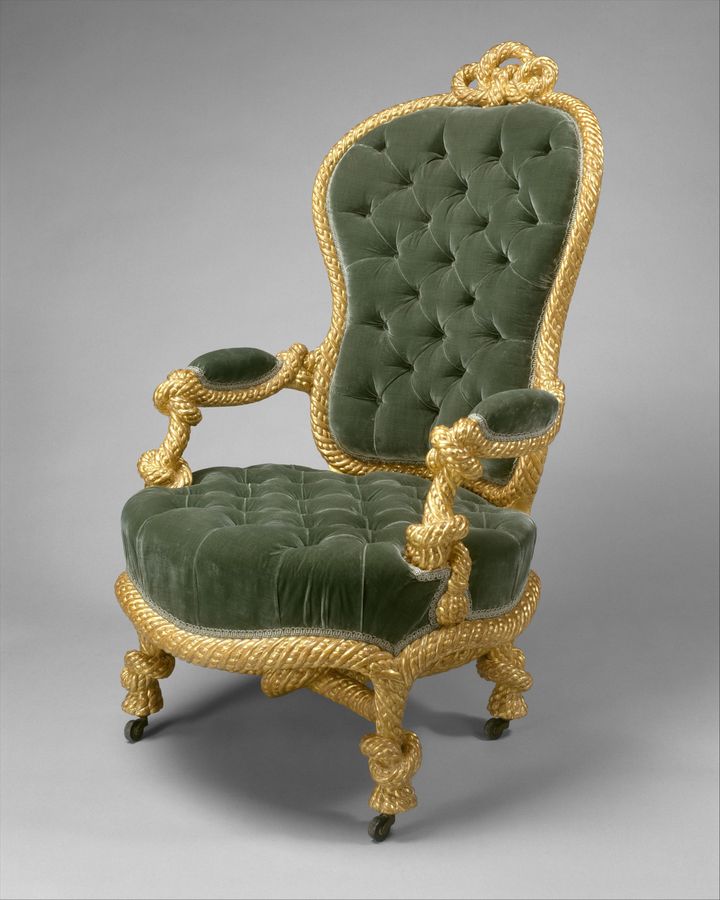
The Napoléon III style (1852 to 1870) is the style of eclecticism: it reinterprets every past style (neo-Renaissance, the neo-Louis XVI so dear to Empress Eugénie, neo-Boulle) and invents modern comfort with buttoned, upholstered seating. Ebonised wood, brass, mother-of-pearl and papier-mâché are its hallmarks.
- Period
- 1852 – 1870
- Line
- Eclectic
- Ornament
- Brass, mother-of-pearl, buttoned upholstery
- Woods
- Ebonised pearwood, rosewood
Context
The Industrial Revolution and a newly prosperous bourgeoisie transformed the furniture market. Machines made series production possible, while the great luxury cabinetmakers showed virtuoso pieces at the Expositions Universelles of 1855 and 1867. Empress Eugénie brought the Marie-Antoinette taste back into fashion.
Timeline
- 1852Proclamation of the Second Empire.
- 1853Marriage of Napoléon III and Eugénie de Montijo.
- 1855Paris Exposition Universelle.
- 1867Second Paris Exposition Universelle.
- 1870Fall of the Second Empire.
How to recognise the Napoléon III style
- Ebonised wood — stained pear or beech, inlaid with brass, mother-of-pearl or tortoiseshell.
- Reinterpretation of earlier styles — Boulle, Louis XV, Louis XVI, Renaissance.
- Fully buttoned seating — sprung: crapaud, pouf, confident, indiscret.
- Papier-mâché — black-lacquered and inlaid with mother-of-pearl.
- Lavish gilt-bronze mounts — porcelain and painted plaques.
- Signs of machine production — regular saw marks and industrial screws, even on fine pieces.
Signature pieces: crapaud armchair, confidante, indiscret, pouf, bonheur-du-jour, side cabinet, games table, Neo-Renaissance cabinet.
The Napoléon III style and its neighbours
| Feature | Restauration | Napoléon III | Art Nouveau |
|---|---|---|---|
| Period | 1815 – 1830 | 1852 – 1870 | 1890 – 1914 |
| Line | Softened, rounded | Eclectic | Curving, plant-inspired |
| Legs | Hocked or scroll legs | All styles, castors | Straight-grained and burr |
| Ornament | Inlaid rosettes and palmettes | Brass, mother-of-pearl, buttoned upholstery | Umbels, water lilies, insects |
| Woods | Maple, lemonwood, ash | Ebonised pearwood, rosewood | Walnut, mahogany, fruitwoods |
A Napoléon III piece 'in the Louis XVI style' betrays itself through machine work (even saw cuts, industrial screws, perfectly identical dovetailed drawers) and through mounts that are often less crisply chased. The finest pieces from the luxury workshops (Beurdeley, Fourdinois) are nonetheless of remarkable quality and much sought after.
The Great Names
- Henri-Auguste Fourdinois (1830 – 1907), luxury cabinetmaking of the highest order.
- Charles-Guillaume Diehl (1811 – 1885), cabinetmaker and maker of fine boxes and small luxury wares.
- Guillaume Grohé (1808 – 1885), cabinetmaker to the Empress.
- Alfred Beurdeley (1847 – 1919), copies and reinterpretations of 18th-century furniture.
The art of buttoned upholstery
The Second Empire brought a technical revolution into general use: the steel coil spring, set into the seat and sometimes the back, beneath a horsehair stuffing. The upholsterer then drew the fabric down deeply with buttoning – buttons or stitches forming a lattice of diamonds. In the most characteristic chairs, the wood all but disappears beneath the upholstery, fringes and passementerie tassels.
- The confidant seats two people side by side but facing opposite ways, in an S shape; the indiscret seats three.
- The pouffe is a seat with no visible woodwork, often circular; the round salon borne is crowned by a central backrest.
- The chauffeuse, a low armless chair, brings its occupant closer to the fire.
Original upholstery, even when worn, is rare: it sheds light on the fabrics and techniques of the period. See also our antique seating.
Boulle Revival and ebonised wood
The taste for the 17th century revived the brass and tortoiseshell marquetry perfected by André-Charles Boulle. Second Empire workshops produced it in quantity: side cabinets, bracket clocks, bonheurs-du-jour and caskets. The more regular cutting of the brass sheets, tortoiseshell sometimes replaced by stained horn or a painted ground, and drier gilt-bronze mounts set these pieces apart from their earlier models.
Ebonised wood – pear or beech stained black in imitation of ebony – provides the ground for inlays of brass, mother-of-pearl and ivory, and for painted porcelain plaques.
Industry and new materials
The Second Empire embraced industrial processes without reservation. The Christofle firm developed electrogilding and electroplating, which gradually replaced mercury gilding; electrotyping made it possible to reproduce objects in relief with great fidelity. Ferdinand Barbedienne popularised mechanical reductions of famous sculptures, thanks to the process devised by Achille Collas. Spelter, a zinc-based alloy cheaper than bronze, became the norm for everyday clocks and statuettes. Lacquered papier-mâché and the bending of solid wood, popularised by the Austrian Michael Thonet, complete the picture.
Examining a Napoléon III piece
- Bronze or spelter: spelter is lighter, pale grey beneath the patina or gilding, and snaps or breaks rather than bending. A discreet check beneath a base is often enough.
- Brass and mother-of-pearl: inlaid brass tends to lift with changes in humidity; losses to the mother-of-pearl and touched-up ebonising are common.
- Seat furniture: lift the bottom cloth to see the frame, springs and horsehair; foam padding indicates re-upholstery.
- Earlier styles: a Second Empire "Louis XVI" piece is a piece in the style; compare it against the criteria for period Louis XVI.
Frequently asked questions
What is a crapaud armchair?
Is Napoléon III furniture valuable?
What is spelter?
What is the difference between a confident and an indiscret?
How can you tell if buttoned upholstery is original?
Sources: Guillaume Janneau, Les Styles du meuble français, PUF, 'Que sais-je ?' series · Musée des Arts décoratifs, Paris — permanent collections · Musée d'Orsay, decorative arts collections · Musée de l'École de Nancy.