At a glance
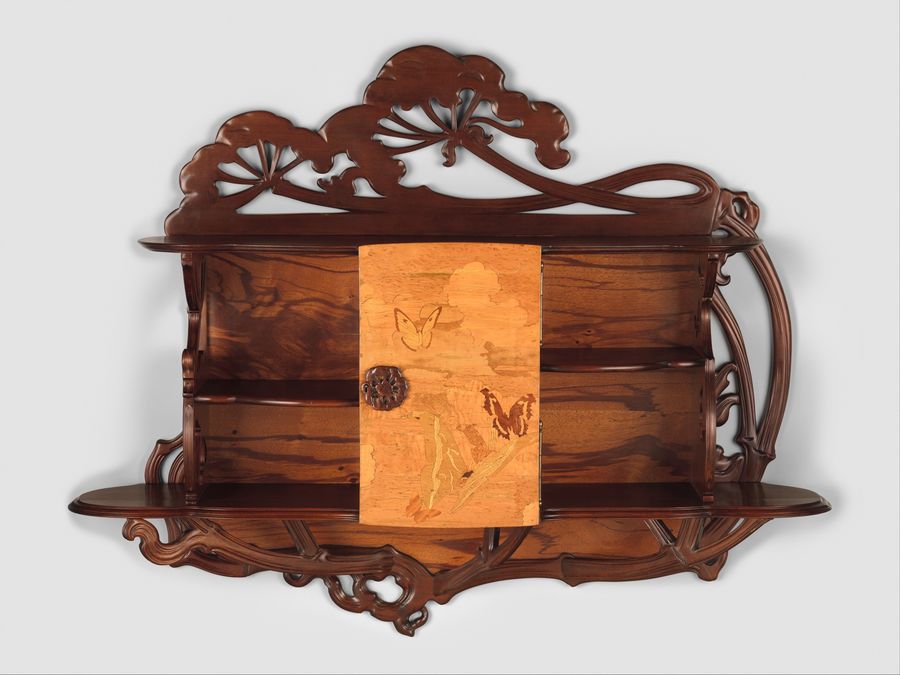
Art Nouveau (c. 1890 to 1914) broke with the imitation of historical styles and turned to nature for inspiration: sinuous 'whiplash' lines, plant motifs (umbels, water lilies, orchids) and insects. In France it flourished in Nancy around Émile Gallé and Louis Majorelle, and in Paris with Hector Guimard.
- Period
- 1890 – 1914
- Line
- Curving, plant-inspired
- Ornament
- Umbels, water lilies, insects
- Woods
- Walnut, mahogany, fruitwoods
Context
In the late 19th century, European artists rejected eclecticism in favour of a 'new art' grounded in the observation of nature and the unity of the arts. The dealer Siegfried Bing gave the movement its name when he opened his Paris gallery 'L'Art Nouveau' in 1895. In Nancy, Gallé united glassmakers, cabinetmakers and ironworkers within the École de Nancy.
Timeline
- 1895Siegfried Bing opens the 'L'Art Nouveau' gallery in Paris.
- 1900Exposition Universelle in Paris; Guimard's first Métro entrances.
- 1901Founding of the École de Nancy, with Émile Gallé as president.
- 1904Death of Émile Gallé.
- 1914The war brings the movement to an end.
Recognising Art Nouveau
- Curving, asymmetrical lines — inspired by stems, roots and flowers.
- Naturalistic marquetry — flowers, landscapes, dragonflies, often accompanied by mottoes.
- Plant-form bronzes and mounts — shaped as stems, leaves and water lilies.
- Acid-etched glass — multi-layered, by Gallé and Daum.
- Unified decoration — the artist often designed the entire interior.
- Common signatures — marquetry signed Gallé, L. Majorelle stamp.
Signature pieces: vitrine, plant stand, guéridon, complete dining-room suite, cameo glass vase and lamp, plique-à-jour enamel jewellery.
Art Nouveau and its neighbours
| Feature | Napoléon III | Art Nouveau | Art Deco |
|---|---|---|---|
| Period | 1852 – 1870 | 1890 – 1914 | 1920 – 1940 |
| Line | Eclectic | Curving, plant-inspired | Geometric, streamlined |
| Legs | All styles, castors | Straight-grained and burr | Tapered legs or solid plinths |
| Ornament | Brass, mother-of-pearl, buttoned upholstery | Umbels, water lilies, insects | Chevrons, flower baskets, sunbursts |
| Woods | Ebonised pearwood, rosewood | Walnut, mahogany, fruitwoods | Macassar ebony, rosewood, amboyna |
Art Nouveau differs from its successor, Art Deco, through its curves and naturalism, whereas Art Deco favours geometry and stylisation. Caution: Gallé and Daum glass has been widely copied in modern times; the etching, weight and signature should be examined by a specialist.
The Great Names
- Émile Gallé (1846 – 1904), glassmaker, cabinetmaker and founder of the École de Nancy.
- Louis Majorelle (1859 – 1926), cabinetmaker and ironworker in Nancy.
- Hector Guimard (1867 – 1942), architect of the Paris Métro entrances.
- Eugène Gaillard (1862 – 1933), cabinetmaker for Bing's pavilion at the 1900 Exposition.
Nancy: Workshops and Craftsmen
In Nancy, Art Nouveau was a matter of workshops. Émile Gallé, a glassmaker by training, opened a cabinetmaking workshop in the 1880s and developed a naturalistic marquetry filled with the plants of Lorraine. Louis Majorelle turned the family business into a true art industry, with its own ironwork and bronze workshops. Around them worked Eugène Vallin, known for furniture carved from the solid, the Daum brothers, glassmakers, and Jacques Gruber, creator of stained glass and bookbindings.
These workshops produced both exceptional pieces for the Expositions and small-series models for a bourgeois clientele, which explains the wide variation in quality among signed furniture.
Paris and Bing's Art Nouveau
Parisian Art Nouveau is more abstract than that of Nancy. Hector Guimard designed the Castel Béranger, completed in 1898, down to the smallest detail: façade, wallpapers, ironwork and door handles. For the 1900 Exposition, Siegfried Bing entrusted his pavilion to Eugène Gaillard, Georges de Feure and Edward Colonna, who created elegant furniture in which the plant motif is stylised rather than described.
Glass, Jewellery and Ceramics
- Glass: multi-layered glass, acid-etched and wheel-finished, inclusions, and glass marquetry patented by Gallé in 1898; Daum later developed pâte de verre with Amalric Walter.
- Jewellery: René Lalique transformed the jeweller's art by combining gold, plique-à-jour enamel, horn, glass and semi-precious stones, prizing decorative effect over the value of the materials.
- Ceramics: the flambé stoneware of Alexandre Bigot and Auguste Delaherche, with its flowing glazes, converses with architecture and furniture.
Posthumous production and copies
After Émile Gallé's death in 1904, the firm continued trading into the 1930s; for a few years, a small star preceded the signature in tribute to its founder. The industrial glass of this period, often mass-produced, should not be confused with pieces designed in Gallé's lifetime. Likewise, after 1914 Majorelle produced more restrained furniture, already close to Art Deco.
Recent copies of 'Gallé' and 'Daum' lamps and vases abound: shallow etching, garish colours, an overly regular signature and lightweight glass should all raise suspicion.
Examining Art Nouveau furniture
On a piece of furniture, look closely at the marquetry: the variety and choice of woods, the precision of the cutting, and any inlaid signature consistent with the piece. Check that the plant carvings are cut from the solid rather than applied, and that the mounts or ironwork match the workshop's known models. Drawers and backboards should show wear and patina consistent with the rest of the piece.
Frequently asked questions
What is the École de Nancy?
How can you tell a genuine Gallé vase?
What does the star before the Gallé signature mean?
What is pâte de verre?
Does Art Nouveau exist outside France?
Sources: Guillaume Janneau, Les Styles du meuble français, PUF, 'Que sais-je ?' series · Musée des Arts décoratifs, Paris — permanent collections · Musée d'Orsay, decorative arts collections · Musée de l'École de Nancy.