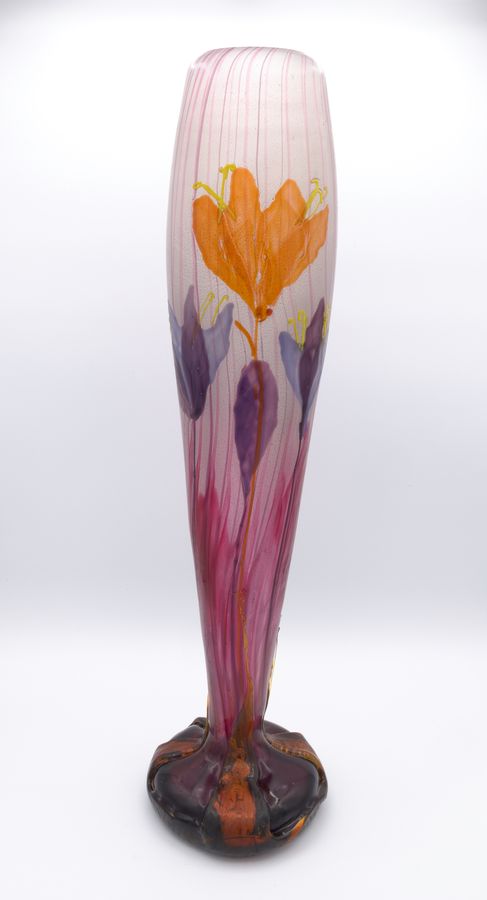
In brief: Émile Gallé (1846–1904) is the leading figure of Nancy Art Nouveau. A glassmaker of genius, he invented new techniques (engraved multi-layered glass, glass marquetry); as a cabinetmaker, he created furniture inlaid with flowers and inscriptions. In 1901 he founded and presided over the École de Nancy.
Biography
The son of a Nancy faience maker and glass merchant, Gallé studied botany, which he would tirelessly translate into glass and wood. He took over the family business and opened a cabinetmaking workshop in the 1880s.
Acclaimed at the Expositions Universelles of 1889 and 1900, in 1901 he founded the Alliance provinciale des industries d’art, known as the École de Nancy. After his death in 1904, the firm continued a more industrial output until the 1930s.
Identifying a piece
- ‘Gallé’ signature, engraved, in cameo or in marquetry.
- Multi-layered glass, acid-etched and finished on the wheel.
- Botanical motifs: umbellifers, orchids, dragonflies, Lorraine landscapes.
- Furniture with floral marquetry, often accompanied by poetic inscriptions.
The making of an all-round creator
After school in Nancy, Gallé continued his training in Germany, notably in Weimar, where he studied drawing, mineralogy and botany. He then served an apprenticeship at the Meisenthal glassworks in Lorraine, which would long produce the firm's glass. A trip to London introduced him to the collections of the future Victoria and Albert Museum and to Japanese art.
He took over his father's business in the 1870s, first in faience and then in glass, and in the mid-1890s built his own glassworks in Nancy. Japonisme, botany and poetry remained the three wellsprings of his art.
Glass as a laboratory
Gallé never stopped experimenting: glass coloured in the mass, inclusions of metal foil and air bubbles, patinas, and glass built up in several layers of different colours, later revealed by carving. In 1898 he patented glass marquetry, a technique of inlaying fragments of coloured glass into the still-hot parison.
His most accomplished pieces, known as 'verres parlants' ('talking glass'), bear lines by poets — Victor Hugo, Baudelaire, Maeterlinck — engraved into the glass itself. Alongside these unique pieces, the workshop produced series of more everyday quality, acid-etched, which spread the name far and wide. See our antique glass section.
The cabinetmaker and his furniture
The cabinetmaking workshop, opened in the mid-1880s, produced nesting tables, guéridons, vitrines, étagères and a few grand display pieces. Here Gallé translated his botanical vocabulary into wood: marquetry of native and exotic timbers depicting flowers, insects and landscapes, uprights carved as stems or umbels, and marquetry inscriptions. His last major piece of furniture, the 'Aube et Crépuscule' bed, is held at the Musée de l'École de Nancy, as is the door of his workshops bearing the motto 'Ma racine est au fond des bois' ('My roots lie deep in the woods').
This furniture paved the way for Louis Majorelle and the other Nancy cabinetmakers.
Signatures, posthumous production and copies
Signatures vary with technique and period: engraved with a point, in cameo within the decoration, or in marquetry on furniture. After Gallé's death in 1904, a star preceded the signature for a few years as a mark of mourning. Posthumous production, largely industrial and acid-etched, continued until the firm closed in the 1930s.
The market is awash with modern copies, sometimes marked 'Tip' before the name. Genuine glass shows crisp, well-differentiated carving, clear layers of colour and a signature integrated into the decoration. A signature scratched in later, blurred decoration or glass that feels too light should raise suspicion.
Where to see his work
Musée de l’École de Nancy, Musée d’Orsay, Musée des Arts Décoratifs (Paris).
Frequently asked questions
How can you tell a piece made in Gallé's lifetime from a posthumous one?
Is Gallé furniture always signed?
Sources: Guillaume Janneau, Les Styles du meuble français, PUF, ‘Que sais-je ?’ series · Musée des Arts Décoratifs, Paris — permanent collections · collections of the museums cited.