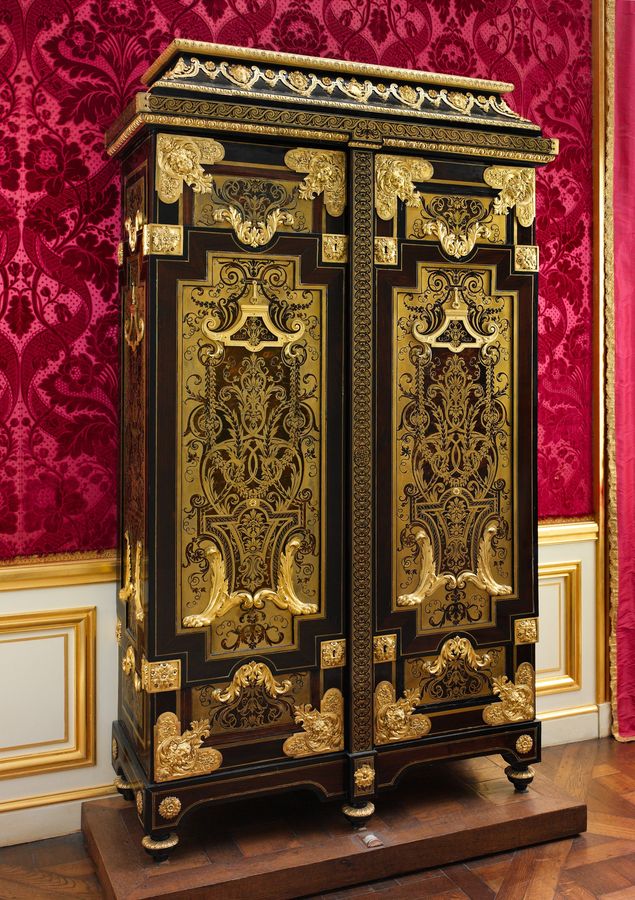
At a glance: André-Charles Boulle (1642–1732) is the most celebrated cabinetmaker of the reign of Louis XIV. Appointed cabinetmaker to the king in 1672 and lodged in the galleries of the Louvre, he perfected the tortoiseshell and metal marquetry that now bears his name. His furniture, of unrivalled richness, was copied well into the 19th century.
Biography
The son of an ebony joiner, Boulle was at once cabinetmaker, chaser, gilder and marquetry craftsman, which allowed him to design both his furniture and its mounts. Lodged at the Louvre, he was exempt from guild rules and worked for the king, the royal family and the great figures of the court.
In 1720 a fire destroyed his workshop, together with his models and stocks of timber. His sons carried on the business. ‘Boulle’ marquetry later enjoyed several revivals, under Louis XVI and again under Napoléon III.
Identifying a piece
- Marquetry of tortoiseshell and brass, sometimes pewter, in ‘première partie’ or ‘contre-partie’.
- Boldly chased gilt-bronze mounts: masks, mascarons, foliage.
- Monumental, symmetrical forms of the Louis XIV style.
- No stamp: attribution rests on archival records and comparison.
An artist of many talents
Lodged in the galleries of the Louvre from 1672, Boulle is described in official documents as cabinetmaker, chaser, gilder and marquetry worker all at once. His status as a craftsman privileged by the king placed him beyond the jurisdiction of the Parisian guilds: he could bring joiners, marquetry workers, founders and gilders together under one roof, something no master of the Faubourg Saint-Antoine was permitted to do. He designed his models himself and oversaw every stage of their making, from carcass to bronze.
His workshop worked for the Bâtiments du Roi, notably for Versailles, but also for the Grand Dauphin, the princes of the blood, financiers and foreign courts. A great collector of drawings and prints, Boulle lost part of this treasure in the fire of 1720, a disaster from which his workshop never fully recovered.
Major works
- The two commodes delivered in 1708 for the King's bedchamber at the Grand Trianon, now at Versailles, are among the earliest commodes in the history of French furniture.
- The large armoires decorated with marquetry and bronzes, of which the Louvre and the Wallace Collection hold major examples.
- Bureaux plats, cabinets on stands, pedestals, plinths and clock cases, often conceived in pairs.
- A volume of engravings, the Nouveaux desseins de meubles et ouvrages de bronze et de marqueterie, which spread his designs and inspired later copies.
It is often forgotten that Boulle also practised, especially early in his career, a highly virtuoso wood marquetry decorated with flowers, birds and vases.
His sons and his legacy
Four of his sons, including Charles-Joseph Boulle, carried on the Louvre workshop after his death in 1732; it was under Charles-Joseph, moreover, that the young Jean-François Oeben trained. Under Louis XVI, the taste for “Boulle furniture” revived: cabinetmakers such as Étienne Levasseur restored, completed or reinterpreted pieces from the Grand Siècle. In the 19th century the technique was industrialised in France and in England, where it became known as Boulle work, and in 1886 Boulle's name was given to a Parisian school of applied arts that is still active today.
Examining a so-called “Boulle” piece
The term refers to a technique, not a maker: the vast majority of “Boulle” furniture on the market was made later. A few points to look at:
- the carcass: oak cut and joined by hand in period pieces, machine-sawn timber and regular joints in the 19th century;
- the thickness of the brass and the engraving of the metals, crisper on early pieces;
- the bronzes: fineness of the chasing, mercury gilding, old fixing marks;
- documented provenance, the only real basis for an attribution to the master's workshop.
Our guide to authenticating furniture covers these examinations in detail.
Where to see his work
Musée du Louvre, Palace of Versailles, Wallace Collection (London), J. Paul Getty Museum (Los Angeles).
Frequently asked questions
What is “contre-partie” in Boulle furniture?
Why is Boulle furniture not stamped?
Is a Napoléon III “Boulle” piece valuable?
Sources: Guillaume Janneau, Les Styles du meuble français, PUF, ‘Que sais-je ?’ series · Musée des Arts Décoratifs, Paris — permanent collections · collections of the museums cited.