At a glance
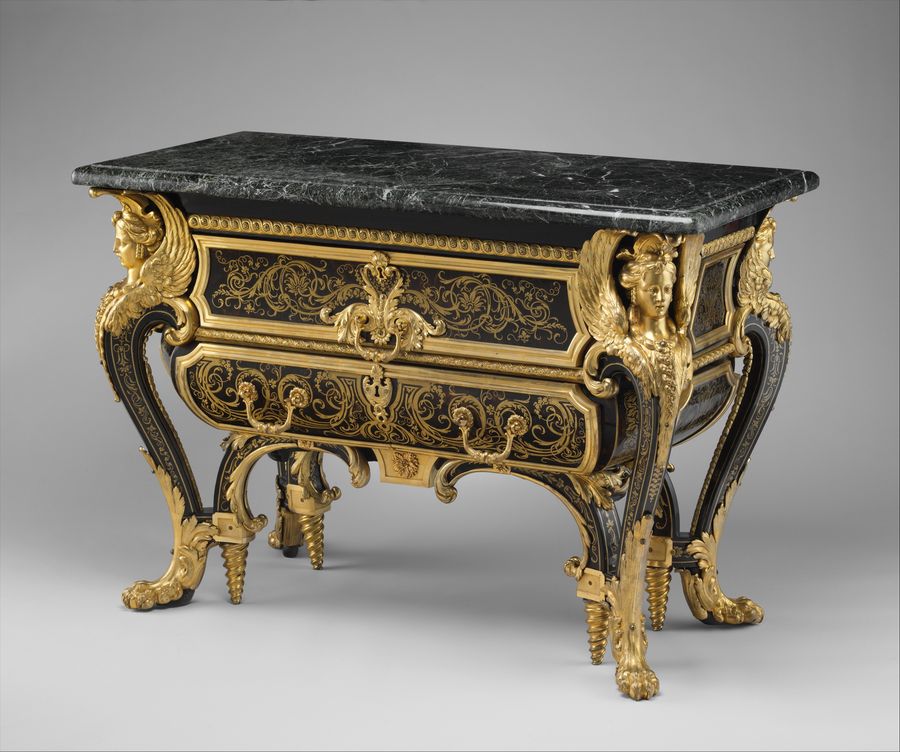
The Louis XIV style (c. 1660 to 1715) expresses the majesty of the Sun King: symmetry, monumental scale, carved and gilded wood, tortoiseshell and brass Boulle marquetry, and gilt-bronze mounts. Driven by Colbert and the painter Charles Le Brun, the Gobelins manufactory defined a court art imitated throughout Europe.
- Period
- 1660 – 1715
- Line
- Symmetrical, monumental
- Ornament
- Sunburst, acanthus, mascarons
- Woods
- Giltwood, ebony, tortoiseshell
Context
In 1661, Louis XIV began to rule alone. Colbert marshalled the arts in the service of royal prestige: the Gobelins manufactory, acquired in 1662, became in 1667 the Manufacture royale des meubles de la Couronne, directed by Le Brun. Cabinetmakers, sculptors, bronze casters and tapestry weavers worked there side by side for the Louvre and later Versailles. Furniture became an instrument of power.
Timeline
- 1661Louis XIV begins his personal rule.
- 1662Colbert acquires the Gobelins for the Crown.
- 1667Founding of the Manufacture royale des meubles de la Couronne, directed by Le Brun.
- 1672André-Charles Boulle is granted lodgings at the Louvre as cabinetmaker to the King.
- 1682The court settles at Versailles.
- 1715Death of Louis XIV.
How to recognise the Louis XIV style
- Perfect symmetry — in both silhouette and decoration.
- Baluster, tapering or scroll legs — joined by X- or H-shaped stretchers.
- Carved and gilded wood — for consoles, guéridons, seating and frames.
- Boulle marquetry — of tortoiseshell, brass and pewter, in ‘première partie’ and ‘contre-partie’.
- Gilt-bronze mounts — mascarons, masks, sabots, escutcheons.
- Royal motifs — the sun, fleurs-de-lis, acanthus leaves, lambrequins, symmetrical shells.
- High, rectangular-backed armchairs — scrolled arm supports, upholstered in velvet or tapestry.
Signature pieces: eight-legged bureau Mazarin, cabinet, wall-mounted console table, guéridon candlestand, Boulle armoire and, around 1700, the first commodes.
The Louis XIV style and its neighbours
| Feature | Louis XIII | Louis XIV | Régence |
|---|---|---|---|
| Period | 1610 – 1660 | 1660 – 1715 | 1715 – 1730 |
| Line | Straight, massive | Symmetrical, monumental | Symmetrical curves |
| Legs | Turned, joined by stretchers | Baluster, tapering gaine | Cabriole, with hoof feet (‘pied de biche’) |
| Ornament | Turning, diamond-point carving | Sunburst, acanthus, mascarons | Shells, espagnolettes |
| Woods | Walnut, oak, ebony | Giltwood, ebony, tortoiseshell | Kingwood, satinwood, walnut |
Louis XIV furniture is recognisable by its rigorous symmetry, straight legs joined by stretchers and ceremonial decoration. The Régence that follows retains the symmetry but introduces the cabriole leg and lightens the forms. Beware: Boulle marquetry enjoyed major revivals under Louis XVI and again under Napoléon III; many ‘Boulle’ pieces date from the 19th century.
The Great Names
- André-Charles Boulle (1642 – 1732), cabinetmaker to the King and master of tortoiseshell and brass marquetry.
- Pierre Golle (c. 1620 – 1684), cabinetmaker to Mazarin and later to the King.
- Domenico Cucci (c. 1635 – 1705), cabinetmaker and bronze caster at the Gobelins.
Seating of the Grand Siècle
The Louis XIV armchair is broad, with a tall rectangular back, slightly reclined, and stands on baluster, tapering pilaster or scroll legs joined by an H-shaped and, increasingly, an X-shaped stretcher. The scrolled arms rest on baluster or scroll supports. The upholstery, often Genoa velvet, damask or tapestry, covers both back and seat and is sometimes trimmed with fringing.
At court, seating expressed rank: the armchair was reserved for the king and the most exalted personages, the side chair for those next in precedence, and the tabouret or folding ployant stool for everyone else. The ‘droit au tabouret’, which allowed certain ladies to sit in the queen’s presence, illustrates this etiquette. Towards the end of the reign, more comfortable seats appeared, such as the wing armchair known as a ‘confessionnal’.
Giltwood and Silver Furniture
Console tables, guéridons, frames and ceremonial seats were carved in wood and then gilded. Water gilding is laid in gold leaf over several coats of gesso made from chalk and glue, allowing the details to be recut before gilding; certain areas are then burnished with an agate stone to create a contrast between matt and gleaming surfaces.
Versailles also boasted spectacular solid silver furniture: tables, guéridons, torchères and orange-tree tubs. It was melted down in 1689 to finance the kingdom’s wars. The giltwood furniture that replaced it often echoes its forms and motifs.
Ornament Designers and the Spread of the Style
Louis XIV ornament spread through engraved pattern books. Jean Lepautre published sumptuous designs for chimneypieces, alcoves and beds. Jean Berain, draughtsman to the King’s Chamber, developed light-hearted grotesques of scrolling foliage, canopies and figures, which recur in many marquetry pieces by André-Charles Boulle. After the revocation of the Edict of Nantes in 1685, the Protestant Daniel Marot settled in the Dutch Republic and went on to work for William of Orange, helping to spread French taste in the Netherlands and England.
The style in the decorative arts
The Grand Siècle forms a coherent whole in which furniture echoes the other arts. The Gobelins wove the great royal tapestries, the Savonnerie manufactory produced carpets patterned with acanthus and flowers, and clockmakers housed their movements in Boulle marquetry cases, such as the so-called “religieuse” clocks with architectural pediments. Mirrors, still costly, were framed in giltwood or marquetry.
Advice for buyers
- Tortoiseshell and brass marquetry is fragile: lifting and losses are common, and any restoration should be disclosed.
- Many low cabinets in ebonised pearwood and brass date from the Second Empire, which adored this repertoire; they are in the style, not of the period.
- Old giltwood shows wear to the gilding on the raised areas, revealing the gesso or red bole beneath; uniform, fresh gilding suggests regilding.
Before any work is carried out, read our guide restoring without reducing value.
Frequently asked questions
What is Boulle marquetry?
How to date Boulle furniture
Is Louis XIV furniture stamped?
Why is it called a “Mazarin desk”?
What is a tapering pedestal (gaine) leg?
Sources: Guillaume Janneau, Les Styles du meuble français, PUF, ‘Que sais-je?’ series · Musée des Arts décoratifs, Paris — permanent collections · Musée du Louvre, Department of Decorative Arts · Mobilier national.