At a glance
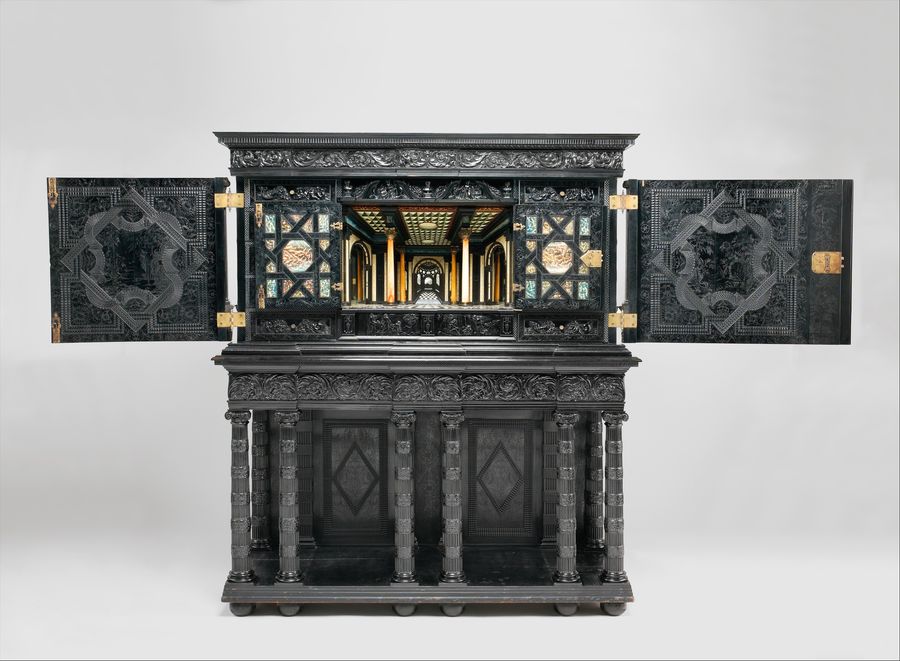
The Louis XIII style (c. 1610 to 1660) marks the birth of modern French furniture: massive, rectilinear forms, turned wood in bobbin, baluster or barley-twist patterns, and legs joined by stretchers. The menuisiers en ébène who veneered cabinets in precious woods at the time gave rise to the word ‘ébéniste’.
- Period
- 1610 – 1660
- Line
- Straight, massive
- Ornament
- Turning, diamond-point carving
- Woods
- Walnut, oak, ebony
Context
Under Henri IV and then Louis XIII, French furniture remained strongly influenced by Italy and Flanders. As the court gradually ceased to travel, furniture, once designed to be carried from place to place, grew larger. In Paris, craftsmen trained in Antwerp veneered cabinets fitted with numerous drawers in ebony: they were called ‘menuisiers en ébène’, and later ébénistes. The style endured long after the king’s death, through the regency of Anne of Austria and Mazarin’s ministry.
Timeline
- 1610Assassination of Henri IV; regency of Marie de Médicis for the young Louis XIII.
- c. 1620First Parisian ebony cabinets, modelled on those of Antwerp.
- 1643Death of Louis XIII; regency of Anne of Austria and ministry of Mazarin.
- 1661Louis XIV begins his personal rule: the style evolves towards the splendour of Versailles.
Recognising the Louis XIII Style
- Turned legs — bobbin, baluster, olive or barley-twist.
- Stretchers — H- or X-shaped, linking the legs and often turned as well.
- Heavy, rectilinear forms — with sharp angles.
- Carved panels — with diamond points, geometric motifs or cartouches.
- Tall, straight-backed seats — upholstered in leather or tapestry secured with nails.
- Ebony cabinets — on stands, with two doors opening onto numerous drawers.
- Few or no bronze mounts — decoration is carved directly into the wood.
Signature pieces: ebony cabinet, table with turned legs, chair with arms (forerunner of the armchair), coffer, two-part buffet, four-poster bed.
Louis XIII and Neighbouring Styles
| Feature | Louis XIII | Louis XIV |
|---|---|---|
| Period | 1610 – 1660 | 1660 – 1715 |
| Line | Straight, massive | Symmetrical, monumental |
| Legs | Turned, joined by stretchers | Baluster, tapering gaine |
| Ornament | Turning, diamond-point carving | Sunburst, acanthus, mascarons |
| Woods | Walnut, oak, ebony | Giltwood, ebony, tortoiseshell |
More restrained than Renaissance furniture, with its profusion of carving, Louis XIII differs from Louis XIV in its lack of gilding, Boulle marquetry and bronze mounts. Beware: the ‘Louis XIII style’ was copied on a massive scale in the 19th and 20th centuries, and provincial production continued well into the 18th century. Period pieces remain rare.
The Great Names
- Jean Macé (c. 1602 – 1672), menuisier en ébène trained in the Low Countries, granted lodgings in the galleries of the Louvre.
Louis XIII seat furniture
The Louis XIII chair was first and foremost a seat of state. The armchair, with its tall rectangular back and square seat, stands on turned legs joined by an H-stretcher, often supplemented by a turned front stretcher. The arms, straight or gently curved, end in a carved scroll or a simple volute. The upholstery, in leather, needlework tapestry or velvet, is stretched over the frame and secured with large-headed nails, sometimes finished with braid or fringing.
Alongside these ceremonial chairs, interiors held stools, placets and benches, more numerous than seats with backs. Towards the end of the period, the “os de mouton” base with curved legs appeared, heralding the seat furniture of the Louis XIV style.
Wood, turning and veneer
Walnut prevails in the provinces and for fine furniture, oak for the sturdy pieces of northern France; fruitwoods were used for humbler furniture. Decoration comes chiefly from turning, carried out on a hand- or foot-powered lathe, and from relief carving: diamond points, cartouches, lion masks and cherub heads.
Parisian cabinets called for a different technique. Ebony, rare and costly, was used as a veneer over a carcass of more common wood. The fronts are engraved with scenes from mythology, the Bible or romances, framed by ripple mouldings produced on a special machine: these guilloché mouldings are one of the hallmarks of the French cabinet of the period.
Provincial work and later copies
The Louis XIII vocabulary lived on long outside Paris. In many regions, tables, buffets and chairs with turned legs were made well into the 18th century, and sometimes beyond. These pieces are antique, but they are not 'period Louis XIII' in the strict sense: they should be described as in the Louis XIII style, of regional make, with an estimated date.
In the 19th century, historicist taste brought the style back into fashion for dining rooms and libraries. These copies, made in large numbers, can be recognised by their very regular turning, machine-made screws and mechanically sawn timber.
Examining a piece before you buy
- The reverse: old panels show marks from a pit saw or a plane, never the regular striations of a circular saw.
- Joints: pegged mortise-and-tenon joints; pegs standing slightly proud of the surface are common on old pieces.
- Wear: it should be concentrated where hands and feet have rubbed, on the stretchers and the ends of the armrests.
- Later additions: many pieces of furniture have been reassembled from old panelling or salvaged panels; any difference in colour or patina between the parts should put you on your guard.
For a full method, see our guide how to authenticate antique furniture.
Frequently asked questions
Where does the word ‘ébéniste’ come from?
How can you recognise a period Louis XIII chair?
Is Louis XIII furniture rare?
What is an « os de mouton » base?
Is an ebony cabinet necessarily Parisian?
Sources: Guillaume Janneau, Les Styles du meuble français, PUF, ‘Que sais-je?’ series · Musée des Arts décoratifs, Paris — permanent collections · Musée du Louvre, Department of Decorative Arts · Mobilier national.