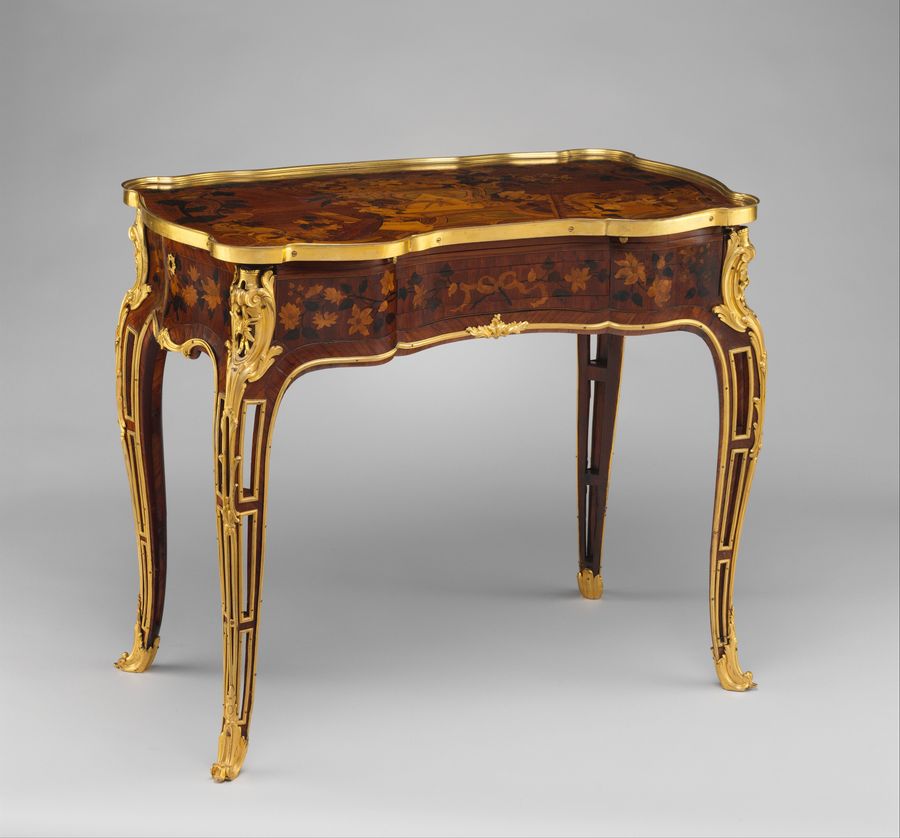
In brief: Jean-François Oeben ranks among the greatest cabinetmakers of the 18th century. Supplier to Madame de Pompadour and later ébéniste du roi, he excelled in floral marquetry and mechanical furniture. He began the celebrated bureau du roi, completed by Riesener in 1769 and now at Versailles.
How to recognise a piece by Oeben
- « J.F. OEBEN » stamp rare: as cabinetmaker to the king he was exempt from guild rules and many of his pieces are unstamped; some stamped pieces date from his widow's management (1763–1767).
- Marquetry of naturalistic flowers, cubes or trelliswork, in kingwood, amaranth and stained sycamore.
- Ingenious mechanisms: sliding tops, secret drawers, metamorphic tables.
- Note: after his death, his widow carried on the workshop; some pieces bear Riesener's stamp or are unstamped.
From the Louvre to the Arsenal
Born in the Rhineland, Oeben arrived in Paris in the 1740s and first worked for Charles-Joseph Boulle, son of André-Charles Boulle, in his Louvre workshop. In 1749 he married Françoise-Marguerite Vandercruse, sister of the cabinetmaker Roger Vandercruse, known as Lacroix. His reputation earned him the title of ébéniste du roi (cabinetmaker to the king) in 1754 and lodgings at the Gobelins, then, from 1756, a workshop at the Arsenal, where he could bring together cabinetmakers, locksmiths and mechanics. Madame de Pompadour, her brother the Marquis de Marigny and leading connoisseurs were among his clients.
The king's desk
In 1760 Louis XV commissioned from Oeben a large roll-top desk for his private study at Versailles. The piece combines one feat after another: a roll top that opens and closes with a single turn of the key, drawers with sophisticated locks, marquetry of trophies and emblems, and exceptionally rich gilt-bronze mounts. Oeben died in 1763 before completing it; his pupil Jean-Henri Riesener delivered it in 1769. Now back at Versailles, the desk is one of the most celebrated pieces of furniture of the 18th century.
Mechanics and marquetry
Oeben made ingenuity his signature. His mechanical tables conceal writing surfaces, mirrors, toilet compartments and reading stands, operated by racks, springs and counterweights. His marquetry moved from the naturalistic bouquets of the Louis XV style towards geometric patterns of cubes, lozenges and ribbons, then to trophies heralding the Transition. His favoured woods – kingwood, amaranth, stained sycamore, holly and boxwood – were often shaded in hot sand to give the flowers depth. In his final years he simplified the curves and paved the way for Neoclassicism.
Workshop, pupils and heirs
His workshop trained a generation of great cabinetmakers: Riesener, Jean-François Leleu and his brother-in-law Martin Carlin, who had married his sister. In debt at his death, Oeben left the workshop to his widow, who ran it with Riesener and continued to use the « J.F. OEBEN » stamp until she married him in 1767. A significant share of the furniture bearing this mark is therefore posthumous. His daughter Victoire would become the mother of the painter Eugène Delacroix.
Attributing a piece to Oeben
For most of his career, as a craftsman under royal protection, Oeben was not obliged to stamp his work; much of it is unmarked and is attributed to him through archives, inventories and comparison of mechanisms and marquetry. A stamp alone is not enough: it may date from the widow's period, and false marks exist. One examines the consistency of the carcass, the working and age of the mechanisms, the quality of the marquetry and the provenance.
Where to see his work
Château de Versailles (the King's desk), Musée du Louvre, Wallace Collection (London), J. Paul Getty Museum (Los Angeles), Metropolitan Museum of Art (New York).
On the market
Pieces stamped by Oeben are rare on the market and rank among the most sought-after French furniture: their price depends above all on provenance, the condition of the marquetry and the originality of the gilt-bronze mounts.
Frequently asked questions
Why was Oeben's workshop based at the Arsenal?
What was the connection between Oeben and Riesener?
Are all mechanical tables by Oeben?
Sources: Rosemarie Stratmann-Döhler, Jean-François Oeben, 2002 · Château de Versailles, entry on the King's desk · Wallace Collection · Getty ULAN.