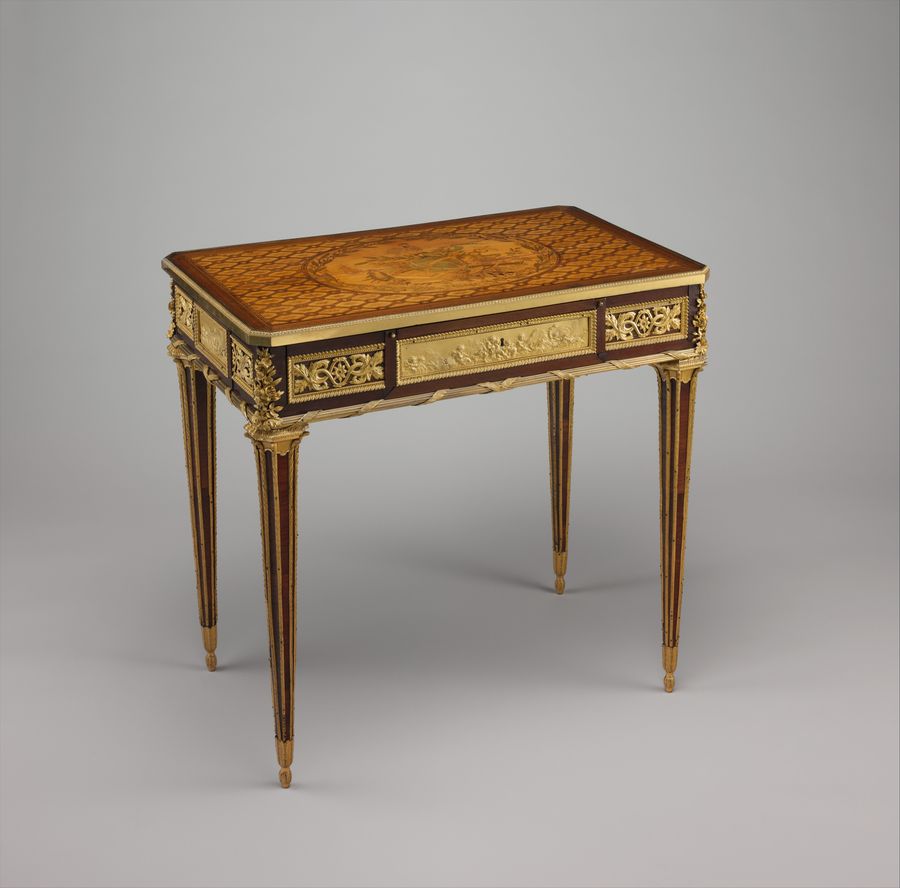
In brief: Jean-Henri Riesener (1734–1806) is the emblematic cabinetmaker of the Louis XVI style. A pupil of Jean-François Oeben, he completed the celebrated roll-top desk of Louis XV in 1769, and in 1774 became cabinetmaker to the Crown, delivering Marie-Antoinette’s finest furniture.
Biography
Born in Westphalia, Riesener joined Oeben’s workshop at the Arsenal. On his master’s death in 1763, he ran the workshop for the widow, whom he married in 1767; he became a master in 1768.
In 1769 he delivered the king's desk, begun by Oeben. Appointed ébéniste ordinaire du mobilier de la Couronne in 1774, he supplied Versailles, Marly and Fontainebleau for a decade. The Revolution brought to an end an activity already in decline since 1784, when the Garde-Meuble turned to other suppliers.
Identifying a piece
- Stamped “J.H.RIESENER”.
- Trellis, lozenge and floral marquetry of remarkable precision.
- Gilt-bronze mounts of exceptional finesse.
- Breakfront commodes, roll-top desks, secrétaires.
From the Arsenal to the Garde-Meuble
Riesener spent his entire career in the workshop he inherited from Jean-François Oeben at the Arsenal, which placed him from the outset at the heart of royal commissions. There he worked alongside other German-born journeymen, among them Jean-François Leleu, who had also hoped to succeed the master and remained his rival for years to come.
The roll-top desk of Louis XV, commissioned from Oeben around 1760 and completed by Riesener, bears his signature and a reference to the Arsenal in marquetry. Preserved at Versailles, it remains one of the most celebrated pieces of 18th-century furniture and sums up the workshop's technical ambition: the cylinder mechanism, pictorial marquetry and gilt-bronze mounts of goldsmith-like quality.
Appointed ébéniste ordinaire to the Crown in 1774, Riesener supplied the Garde-Meuble with commodes, secrétaires, tables and corner cabinets for the apartments of the king, the queen and the royal family. His high prices eventually wore out the administration's patience: from 1784 the Garde-Meuble turned mainly to Guillaume Beneman, although Marie-Antoinette continued to call on him for her private interiors.
An evolving idiom
The furniture of the 1770s remains close to the Transition style: façades with a central breakfront, large marquetry panels depicting trophies, vases or bouquets, framed by lozenge or trellis grounds dotted with flowerheads. The drawing is remarkably crisp, and the stained woods have often lost their original colours, which were far more vivid.
In the 1780s the cabinetmaker favoured plainer surfaces in carefully chosen mahogany, where the decoration is carried by the gilt-bronze mounts: foliate friezes, garlands, moulded frames and chased escutcheons. He also made mechanical furniture — writing and dressing tables with sliding or rising tops — that bears witness to outstanding precision in fitting.
Marks and traces of history
The "J.H.RIESENER" stamp is struck with an iron, usually on the carcass, beneath the marble top or on a rail. Pieces delivered to the Crown sometimes also bear a painted or inscribed Garde-Meuble inventory number, or a château brand. Cross-checked against surviving inventories, these marks make it possible to establish a precise provenance.
After the Revolution, Riesener bought back some of his own furniture at the sales of the royal collections, but failed to resell it in a market upended by new fashions. His son, Henri-François, chose painting and became a portraitist.
Copies and examining a piece
Riesener's prestige inspired many copies in the 19th century, notably under the Second Empire, when Empress Eugénie revived the taste of Marie-Antoinette; the king's desk itself was reproduced several times. These high-quality copies are works of art in their own right, but must not be mistaken for the original.
- Compare the carcass (oak, joints, tool marks) with the quality of the veneer and mounts.
- Examine the reverse of the mounts: chasing, gilding and original fixings.
- Be wary of a lone stamp on a mediocre piece: fake marks do exist.
Our guide How to authenticate antique furniture explains these checks in detail.
Where to see his work
Château de Versailles, Musée du Louvre, Wallace Collection, Waddesdon Manor, Frick Collection (New York).
Frequently asked questions
Did Riesener cast his own bronzes?
What is the difference between Riesener and Oeben?
Sources: Guillaume Janneau, Les Styles du meuble français, PUF, ‘Que sais-je ?’ series · Musée des Arts Décoratifs, Paris — permanent collections · collections of the museums cited.