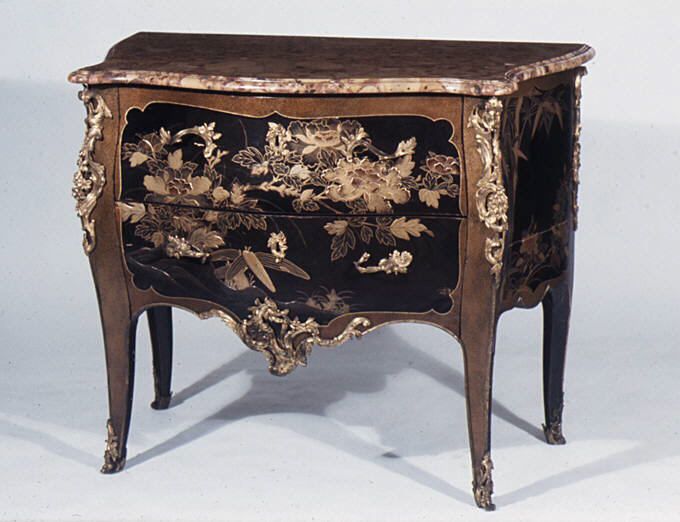
In brief: Jacques Dubois (1694–1763) was one of the great cabinetmakers of the Louis XV style, renowned for his lacquer and varnished furniture with exuberant rocaille mounts. His stamp “I. DUBOIS” was retained by his son René, so attributions call for caution.
Biography
Based in the Faubourg Saint-Antoine, Jacques Dubois worked for many years as an independent craftsman before becoming a master in 1742. He produced commodes, encoignures and desks veneered in East Asian lacquer or European varnish, adorned with highly animated mounts.
After his death, his widow and then his son René Dubois carried on the workshop, using the same stamp. Transition or Louis XVI pieces stamped “I. DUBOIS” are generally attributed to René.
Identifying a piece
- Stamped “I. DUBOIS” (the I standing for J).
- East Asian lacquer or European varnish.
- Highly animated rocaille mounts wrapping around the corners.
- Louis XV style for Jacques; Transition and Louis XVI for his son René.
A master of the Rococo
Jacques Dubois belongs to the generation that gave the Louis XV style its boldest forms. His work is characterised by strongly bombé furniture whose lacquered or marquetry surfaces are quite literally enveloped in gilt-bronze mounts: scrolling corner mounts, escutcheons and handles cast as part of a single decorative scheme, and foliate sabots. He also made more restrained pieces veneered in kingwood or satinwood, as well as large bureaux plats.
His best-known work is a monumental corner cabinet made in the 1740s after a design by the ornamentist Nicolas Pineau for a Polish nobleman, now in the Metropolitan Museum of Art, New York.
Lacquer and varnish
Like other cabinetmakers of the Faubourg Saint-Antoine, Dubois often worked through the marchands-merciers, who supplied panels of East Asian lacquer cut from imported screens or cabinets. Veneered onto curved carcases, these panels had to be thinned and bent – a delicate operation. When genuine lacquer was unavailable, European varnishes were used instead, Parisian imitations that were highly prized. Telling Asian lacquer from European varnish takes a specialist's eye: thickness, crazing and decorative technique all differ. On a piece of this kind, restorations must also be identified: lacquer has often been retouched, revarnished or made up, and a panel that looks too uniform or too glossy should raise suspicion. An original surface, even somewhat worn, is always preferable to one restored to look new.
The workshop after Jacques
On Jacques's death in 1763, his widow kept the workshop, and their son René Dubois (1737–1799), himself received as a master, later took charge of it. René swiftly embraced the forms of the Transition style and then of Neoclassicism, catering to an aristocratic clientele in Paris and abroad. Since the same « I. DUBOIS » stamp continued to be struck, it is the style of a piece, rather than the mark, that distinguishes father from son.
Reading the stamp
Under the statutes of 1743, Parisian master cabinetmakers had to strike their name on their furniture with an iron, and the guild checked quality by applying the JME mark. A genuine "I. DUBOIS" stamp is struck cold into the wood, often at the top of an upright or beneath the top. Be wary, however: stamps that have been transferred, restruck or added to furniture from another workshop do exist. The stamp must always be consistent with the carcass, the style and the mounts. See our stamped commodes.
Where to see his work
Musée du Louvre and major international collections of French furniture.
Frequently asked questions
What does the JME mark mean?
How can you tell whether an "I. DUBOIS" piece is by Jacques or René?
Why "I. DUBOIS" rather than "J. DUBOIS"?
Sources: Guillaume Janneau, Les Styles du meuble français, PUF, ‘Que sais-je ?’ series · Musée des Arts Décoratifs, Paris — permanent collections · collections of the museums cited.