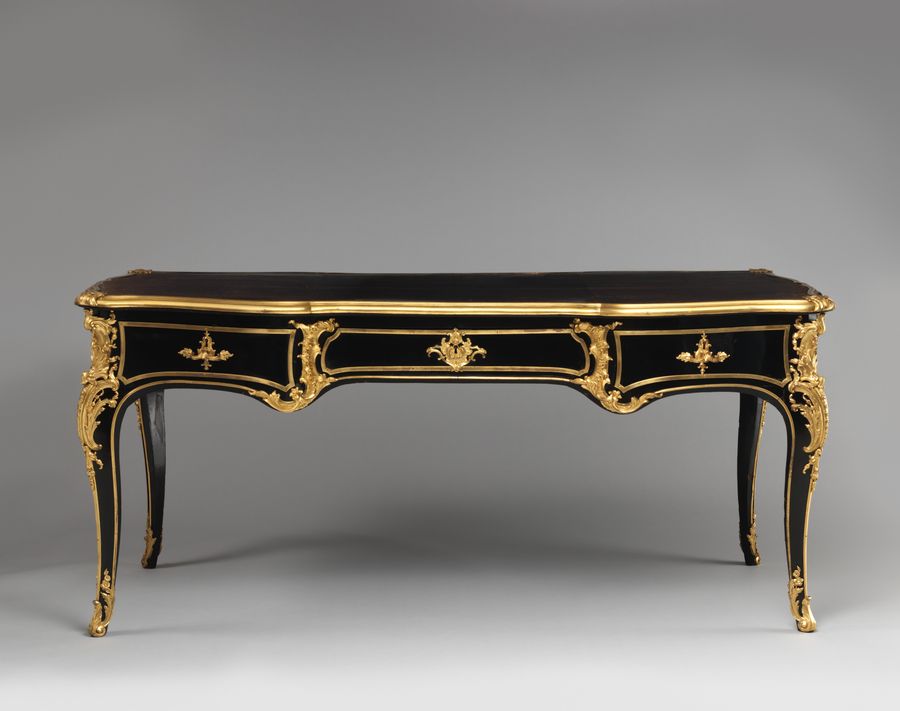
In brief: Bernard II Van Risenburgh (c. 1696 – c. 1766), known by his stamp BVRB, was one of the greatest cabinetmakers of the Louis XV style. Working for the Parisian marchands-merciers, he created furniture of rare elegance, veneered with lacquer, vernis Martin or Sèvres porcelain.
Biography
From a family of cabinetmakers of Dutch origin settled in the Faubourg Saint-Antoine, BVRB worked almost exclusively for the marchands-merciers, who supplied the court and the aristocracy and provided him with lacquer and porcelain.
His stamp long remained a mystery and was only identified in the mid-20th century. His son, Bernard III, carried on the workshop.
Identifying a piece
- Stamped “B.V.R.B.”.
- Panels of East Asian lacquer or vernis Martin, Sèvres porcelain plaques.
- Exceptionally fine floral marquetry, often in end-grain wood.
- Refined small furniture: writing tables, encoignures, commodes.
A stamp deciphered late
For almost two centuries the initials "B.V.R.B." remained a riddle to connoisseurs, who admired some of the most refined Louis XV furniture without being able to name its maker. Only in the mid-20th century did research in the Paris archives identify him as Bernard II Van Risenburgh, son of a cabinetmaker from the Low Countries who had settled in the Faubourg Saint-Antoine. Although he became a master before stamping was made compulsory, he nonetheless marked part of his output.
In the service of the marchands-merciers
BVRB scarcely ever sold directly to the public. His furniture passed through the great Parisian marchands-merciers, such as Thomas-Joachim Hébert, Lazare Duvaux and Simon-Philippe Poirier. These dealers, decorators in all but name, supplied him with precious materials and sold his work on to the royal family, Madame de Pompadour and the highest ranks of the aristocracy.
- Japanese or Chinese lacquer, cut from imported screens or cabinets.
- Parisian varnishes imitating lacquer.
- Sèvres porcelain plaques, from the late 1750s: BVRB was among the first cabinetmakers to adorn furniture with them.
An artistic signature
His forms are of rare lightness: small writing tables, ladies' desks, slant-front secretaires, commodes and corner cabinets with supple curves, raised on very slender cabriole legs. His floral marquetry, often in end-grain wood, traces scrolls and sprays of great delicacy. The bronzes, never excessive, follow the curves of the piece. This balance of elegance and richness makes him one of the high points of the Louis XV style. Around the mid-1760s, his son Bernard III took over the workshop.
Examining a piece stamped BVRB
- The stamp is struck with an iron, sometimes alongside the JME mark, on discreet areas: beneath the top, on a rail, or on the back of an upright.
- Lacquer furniture may have been restored or reworked: check the continuity of the panels and the nature of the decoration.
- Porcelain plaques should be consistent with the period in size and decoration; replaced or later-painted plaques do exist.
- His models were copied in the 19th century, sometimes with a fake stamp: the carcase construction and the quality of the bronzes often give the copy away.
Further reading: how to authenticate antique furniture.
Where to see his work
Musée du Louvre, J. Paul Getty Museum, Metropolitan Museum of Art, Wallace Collection.
Frequently asked questions
What is the difference between lacquer and vernis Martin?
What does BVRB stand for?
What was a marchand-mercier?
Sources: Guillaume Janneau, Les Styles du meuble français, PUF, ‘Que sais-je ?’ series · Musée des Arts Décoratifs, Paris — permanent collections · collections of the museums cited.