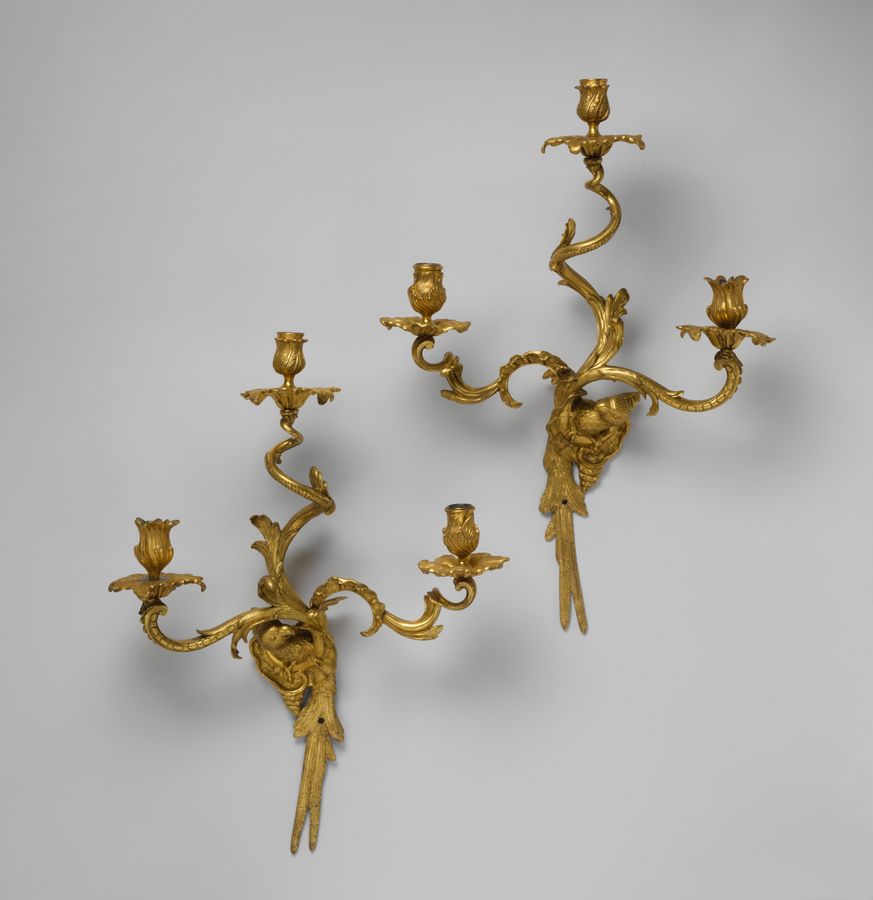
At a glance: Charles Cressent (1685–1768) is the leading figure of Régence cabinetmaking. A sculptor by training and cabinetmaker to the Duc d'Orléans, he created commodes and desks with exceptional gilt-bronze mounts (espagnolettes, dragons, monkeys), which he cast and chased himself, in defiance of guild rules.
Biography
The son of a sculptor from Amiens, Cressent settled in Paris and became official cabinetmaker to the Regent, Philippe d'Orléans, and later to his son. His training as a sculptor accounts for the quality of his mounts, which he produced in his own workshop.
This practice led to several lawsuits brought against him by the guild of founders and chasers. To finance his business, he held sales of his own collection, whose catalogues, written by himself, are an invaluable source.
Identifying a piece
- Sculptural gilt-bronze mounts: espagnolettes, dragons, monkeys, female heads.
- Kingwood and purpleheart veneer, quarter-veneered.
- Bombé commodes with two or three rows of drawers.
- Stamp rare: attributions based on the mounts and on sale catalogues.
From sculptor to cabinetmaker
Trained by his father, then received as a master sculptor at the Académie de Saint-Luc, Cressent came to cabinetmaking through marriage: in 1719 he wed the widow of Joseph Poitou, cabinetmaker to the Regent, and took over his workshop and clientele. He never ceased to present himself as a sculptor, and this dual expertise is the key to his art: in his work, bronze is not an accessory applied to the furniture; it defines its very silhouette.
He worked for the House of Orléans, but also for great financiers, Parisian connoisseurs and foreign princes. Several of his pieces thus found their way very early to princely residences outside France, as the collections of the Munich Residenz attest.
A recognisable style
- Commodes ‘en tombeau’, later bombé, with two tiers of drawers, where the bronze decoration often flows from one drawer to the next, disregarding the division between them.
- Bureaux plats with corners adorned by female busts, the celebrated ‘espagnolettes’, a motif inherited from Watteau and Gillot.
- Medal cabinets, cartel clocks and regulator cases, for which he created bronzes of great inventiveness.
- Kingwood and amaranth veneers, quartered or laid in butterfly patterns, leaving the metal to take centre stage.
His repertoire ranges from the last symmetrical forms of the Régence to the bold curves of the rocaille, making him a privileged witness to this transition.
Lawsuits and sale catalogues
Regulations forbade a cabinetmaker to cast, chase or gild bronzes, work reserved for the founders and gilders. Cressent was prosecuted several times by these guilds, and his bronzes were on occasion seized. To meet his financial difficulties, he repeatedly put his stock and collections up for sale, writing the catalogues himself. These texts, in which he describes his models in precise detail, now make it possible to identify unsigned furniture.
Attribution and caution
Cressent very rarely stamped his furniture, and his bronze models were taken up by other workshops, both in the 18th century and in the 19th century, when the great Parisian workshops reproduced his commodes and desks. A piece ‘in the manner of Cressent’ is therefore not a piece by Cressent. When examining one, look at the consistency between carcass, veneer and mounts, the quality of the chasing and gilding, and above all the provenance. See also our page on stamped commodes.
Where to see his work
Musée du Louvre, Wallace Collection (London), Munich Residenz, Calouste Gulbenkian Museum (Lisbon).
Frequently asked questions
Where can Cressent's furniture be seen?
What does ‘espagnolette’ mean in Cressent's work?
Why did Cressent almost never sign his furniture?
Sources: Guillaume Janneau, Les Styles du meuble français, PUF, ‘Que sais-je ?’ series · Musée des Arts Décoratifs, Paris — permanent collections · collections of the museums cited.