News · AnticPlace
‘The market has been flooded with fakes’: an auctioneer tells Camille Jouneaux how to tell whether a painting is genuine or fake
Genuine or fake painting? Ultraviolet lamp, stamps, catalogue raisonné: an auctioneer reveals how she tracks down forgeries on the art market.
Key points
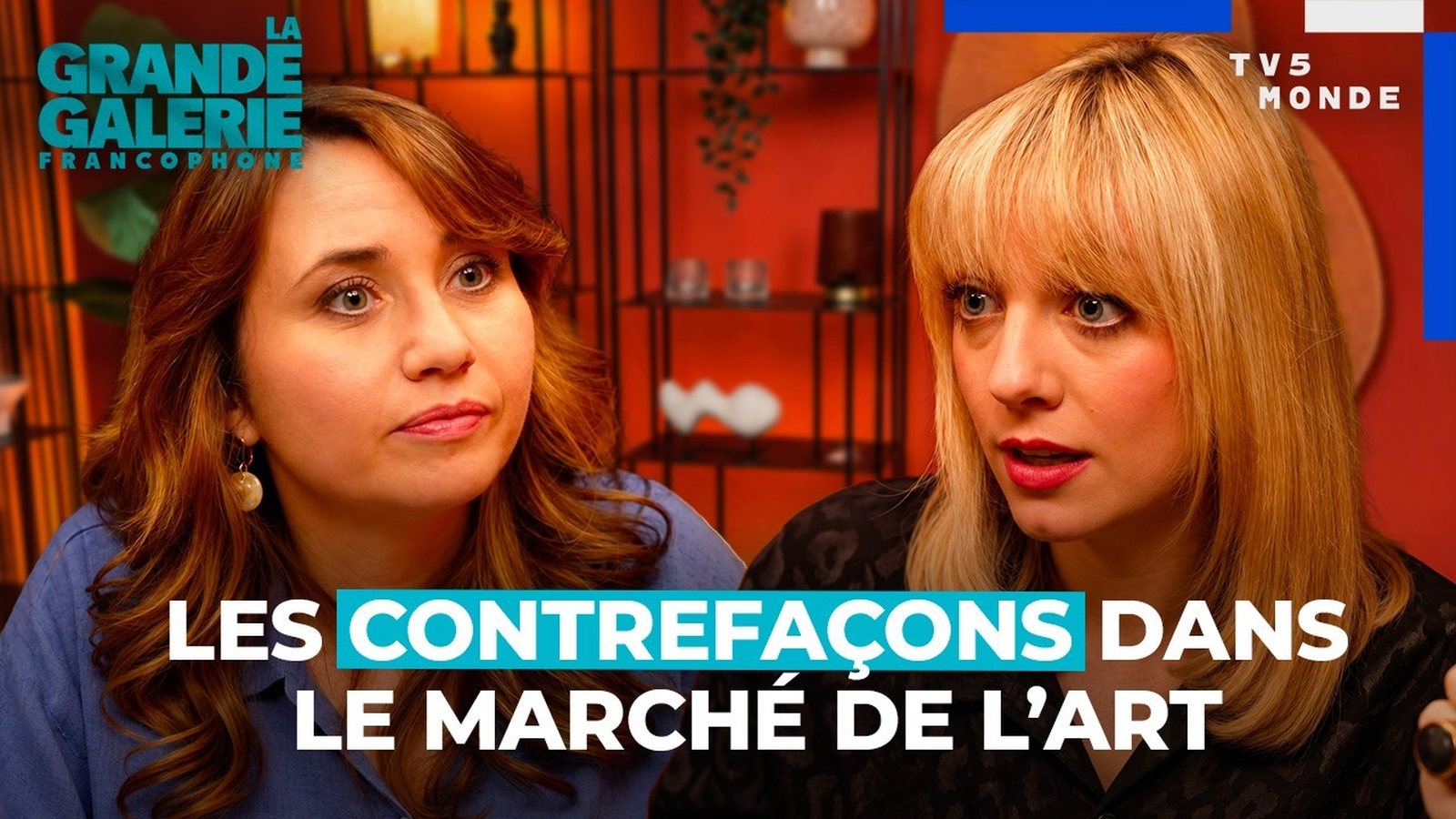
How can you tell whether a painting is genuine or fake? A guest of Camille Jouneaux on ‘Camille Rencontre’ on TV5MONDE, an auctioneer details her investigation: ultraviolet lamp, stamps on the back of canvases, archives and the catalogue raisonné. Vigilance is essential in an art market that, in her view, now holds ‘more fakes than genuine works’.
An art market ‘flooded with fakes’, across every period
Her verdict is blunt. ‘Unfortunately, in our world, there are more fakes than genuine works,’ the auctioneer acknowledges. She insists: ‘The market has been flooded with fakes’, and this applies to every period and every artist. The last time she came across one? The week before the recording.
Vintage resale websites, flea markets, antiques dealers, auction houses where the checks have not been carried out, and even art fairs: she describes ‘a fair in the open air’. Some of these works date from the 1960s, 1970s and 1980s, a period when ‘very fine, very well-made fakes’ circulated, at a time when, without the internet or social media, research was far less easy.
Faced with a doubtful piece, the question remains whether the seller is acting in good faith. For the professional, the answer lies in no technique: ‘it’s purely human,’ she admits.
Genuine or fake painting: the ultraviolet lamp, the investigation’s first step
It all begins with a consignment agreement. The client entrusts the work and, should anything happen to it, is reimbursed at the estimated value. Then comes the research. For a major piece, such as a Rembrandt, the auctioneer calls on a specialist, for instance the Cabinet Turquin, which she describes as one of the leading Old Master painting firms in France.
The first tool is the ultraviolet lamp. In total darkness, often in the toilets, the closest windowless room to the valuation office, the work reveals its overpainting, its retouching and the condition of its signature. A genuine old canvas may bear a name added much later. ‘You can see straight away if the signature was done afterwards,’ she explains.
She cites the case of a fine canvas signed Courbet, whose signature had clearly been applied some twenty years earlier. The tool is not reserved for professionals: anyone can buy one, and she even advises ‘bargain hunters to get one’.
Stamps, archives and the catalogue raisonné: tracing a work’s ‘passport’
‘A work of art has a lot to say,’ the auctioneer sums up. It must be examined, turned over and checked to confirm that it is period. On the reverse, studio stamps can attest to its age. She likens these marks to the customs stamps in a passport: the gallery where the work was first sold, a great collector’s stamp acting much like a bookplate, an inventory number, small labels. Each is a clue to reconstructing its history.
The investigation continues at the Institut national d’histoire de l’art (INHA), described as holding the largest art history documentation in the world. Its registers and collection archives allow persistent researchers to trace works back to sales at Drouot in the 18th and 19th centuries. A ‘dizzying’ task – and one where you also need to know when to stop.
Another reflex: the catalogue raisonné, the reference work listing every known work by an artist. If the canvas on offer is already recorded there as being in a museum, the verdict is clear. ‘Your painting is in the Met in New York, which means it’s a fake,’ she explains, taking Delacroix as an example.
The subject matters too: an early work or a Descent from the Cross, a leading theme in Rembrandt’s day, do not carry the same value. And when her knowledge reaches its limits, she turns to specialists of the artist – authors of books and theses, or exhibition curators. ‘There are things we don’t know, and you have to be able to say so,’ she says.
Fakes destroyed, police alerted: what happens to a work that ‘isn’t right’
A fake must never be put back into circulation. The auctioneer recounts the case of a collection containing two works attributed to Ben, the Fluxus and École de Nice figure known for his handwritten script. One, authentic, sold for €15,000 and was entered in the archives of the artist’s committee. The other was a fake: the committee requested its destruction. Once informed, the client often agrees to destroy the work themselves or to send it back to the committee.
When a situation raises serious suspicions, the police are informed. ‘Holding a work of art that isn’t right is a matter of criminal law,’ she warns. The profession, which is tightly regulated, imposes due-diligence obligations set out in its code of ethics, notably in the fight against money laundering and terrorist financing.
‘How can fakes finance terrorism?’ asks a surprised Camille Jouneaux. The auctioneer describes a laundering mechanism: a stolen work is resold for cash, which is then used to buy weapons and fund a criminal network. Some pieces taken in robberies resurface four years later. This very topic was the subject of this year’s law paper in the competitive examination.
Becoming an auctioneer: two degrees and a highly selective examination
Not just anyone can conduct an auction. To sit the examination, candidates must hold both a law degree and an art history degree. The exam takes place at the École du Louvre: four hours of law in the morning, on the art market and auction sales, followed by a four-hour art history essay in the afternoon. This year 140 candidates sat it, 30 passed the written papers and only 18 were selected after oral examinations in law, art history and English.
Camille Jouneaux’s guest took the reverse route: classics, ancient Greek and philosophy first, then art history and law, for a total of three bachelor’s degrees and a first-year master’s in art history. In the oral examination she drew ‘tapestry in the 18th century’ – having, as it happened, visited the Gobelins the weekend before. ‘They can ask about anything,’ she points out, from art brut to Émile Gallé by way of 18th-century bronze.
Her daily work bears this out: appraising pre-Columbian art, inventorying design pieces, valuing gold jewellery. ‘You can’t know everything,’ she concedes – hence the two years of training that follow the examination, combining courses at the École du Louvre, practical work in museums and placements at auction houses. For her, discovering a previously unknown work, passed from one private collection to another, remains the heart of the profession: ‘that’s also the beauty of our job – being able to rediscover things the public has never yet seen.’